Showing posts with label herptiles. Show all posts
Wednesday, September 30, 2015
Two Cool online resources by Nature Canada!
Found these online resources last month on Nature Canada website:
Nature Hood virtual tour:
This resource highlights all the great spots for bird viewing in the Lac Deschenes area including waterbirds, shorebirds, aerial insectivores and passerines. It provides indepth information on all the popular spots on both sides including Bates island, Baie Simard and Mud Lake! Check it out here.
Nature Hood App:
Nature Canada is also encouraging Ottawa residents to become citizen scientists by mapping sightings of wildlife in public spaces! This includes birds, mammals, herptiles and even insects. It has a great glossary to help when reporting a sighting and there is also the opportunity to virtually explore the entries that are already there on the map. This would be fun for a family outing. Learn more by visiting the website.
And speaking about the Ottawa River - Ottawa Riverkeeper has created a virtual tour for the Voyageur Pathway.
Labels:
Biophilic,
birds,
Canadian project,
connection,
fauna,
fish,
green/blue corridors,
herptiles,
insects,
mammals,
Ottawa,
website resource
Thursday, February 19, 2015
Time to Frog Proof your Yard this Spring (swimming pools and window wells)
From an old 2009 Ottawa Citizen Article worth repeating:
Someone has now created that device to rescue frogs (and other animals including mice) from pools called the Frog Log. Here is a You Tube video showing the product in action: Frog Log (U.S. Company)
The lives of tens of thousands of frogs, toads and salamanders could be saved each year if homeowners made a few simple changes to their homes and yards, says an Ottawa biologist. Dan Brunton said backyard swimming pools are particularly deadly, and he has found up to 10 dead amphibians in the filter of his neighbour's pool before. "The simple thing was they just couldn't get out," Brunton said. "There's a wonderful commercial opportunity in here. Somebody make a nice little floaty ramp. You just leave it there and the critters climb out of your pool every morning." A green frog trapped in the filter earlier this week was luckier than most — it was still alive when Brunton visited the pool to demonstrate the problem to a CBC reporter this week.
While Brunton was renovating his home recently, he discovered another problem for amphibians — window wells. "The day these were put in two toads were found dead the following morning," he said, pointing at his own below-grade basement windows. Brunton has now built gravel slopes in the wells so toads and other critters can climb out — something he encourages other homeowners to do. "Since we've put this simple, simple little ramp in there, not one more animal has died in this thing."
Fraser Veitch, a spokesperson for Benson Pools, a company that sells pool equipment and services, said it's fairly common for frogs to get trapped in pools, but people aren't always sure what to do when it happens.
Someone has now created that device to rescue frogs (and other animals including mice) from pools called the Frog Log. Here is a You Tube video showing the product in action: Frog Log (U.S. Company)
Labels:
backyard,
building design,
business,
connection,
herptiles,
landscaping,
mammals
Wednesday, July 30, 2014
Saving Ontario Salamanders
An East York woman is saving the salamanders of cottage country, rescuing them from local trails and raising them in her backyard.
Carolyn Forbes, 28, says she has collected about 350 yellow and blue-spotted salamander egg sacs, each with the possibility of hatching between 20 and 50 babies, from ditches and dips in local roads near her Highlands cottage near Bancroft.
However, Ontario’s Ministry of Natural Resources does not allow amphibians to be taken from or released into the wild.
Link to Toronto Star News Article
Tuesday, August 27, 2013
Crucial Part of Our Ecosystem
Media Release from Orkin Pest Control Company in Regina:
"As Canadians we cherish the summer months that bring sunshine, warm weather and the urge to spend time outdoors. Inevitably, the summer season also brings pesky critters into the mix, including house flies and the dreaded mosquito. Although these uninvited guests could put a damper on your summer plans, they all play an essential role in nature. At Orkin Canada, we believe that every pest has a place, and while not in our homes, hospitals and public buildings – they are indeed a crucial part of our ecosystem. The following lists the roles they play in the natural environment.
House Fly In Nature: Although they may bug us, flies are an essential part of the food chain. House flies have an important role in nature pollinating plants and recycling all things dead and decaying. It may not seem glamorous but flies play a vital role in assisting the decomposition of dung and decaying matter, plants or animals.
Mosquito In Nature: Mosquitoes are delicious to eat and easy to catch! Mosquitoes are the main course for multiple species including spiders, salamanders, lizards, frogs, bats, birds and multiple species of fish. Without mosquitoes of off the menu, many of these animals would lose a primary food source."
See more at: http://blogs.leaderpost.com/2013/08/20/common-critters-friends-or-foe/#sthash.32vkVtnd.dpuf
Ragnhild Brosvik Mosquito Image from Flickr under Creative Commons
P.S. Check out my latest "urban wild" nature blog: Wild. Here. (2016 update)
Labels:
bats,
birds,
ecosystem services,
fish,
flora,
herptiles,
insects,
living with,
mammals
Saturday, April 6, 2013
MTO Turtle Crossing - Nesting
***THIS IS AN ARTICLE FROM THE MTO WEBSITE - LINK BELOW***
Turtle Crossing and Barriers
The turtle crossing uses an elliptical culvert.
Anti-glare mesh/screen is used as a turtle barrier/fence to restrict turtle movement onto the roadway.
An artificial turtle nesting habitat made of fine crushed stone, sand, and gravel.
Turtle Crossing: Similar to a pipe culvert design for fish crossings (below), the turtle crossing uses an elliptical culvert. The top ends of the culvert have been cut to maximize the amount of light in the culvert, helping to attract wildlife through the culvert. A mesh screen is attached around the area of the culvert opening to prevent turtles from climbing onto the roadway.
Turtle Barrier/Fence: Studies have shown that turtles can climb fences. Anti-glare mesh/screen is used as a turtle barrier/fence to restrict turtle movement onto the roadway. The turtle fence is affixed directly onto the highway fence, and funnels/directs the turtles to the culvert installed underneath the highway. At the North Credit River Bridge, a total of 1028 m of turtle fence was installed. Though the fence is 1 m high, it features a 200 mm 90 degree bend on top that will prevent turtles from climbing and accessing the right-of-way.
Turtle Nesting Habitat: In addition to mitigating the loss of turtles on the highway, MTO and MNR have developed an artificial turtle nesting habitat made of fine crushed stone, sand, and gravel. The habitat was constructed at the ends of the turtle crossing to provide an area for turtle egg laying. This habitat attracts turtles to the crossing due to it's exposure to the sun.
To evaluate the turtle crossing system, a monitoring program will begin in the spring of 2011. Monitoring will continue for the next two years.
For more information on Turtle Crossings, please contact: Luis Orantes, Environmental Planner, Planning & Environment Office, Central Region at (416) 235-3852 or luis.orantes@ontario.ca
Original article found here: http://www.mto.gov.on.ca/english/transtek/roadtalk/rt16-4/index.shtml
P.S. Check out my latest "urban wild" nature blog: Wild. Here. (2016 update)
Tuesday, December 4, 2012
Snapping Turtles Habitat (near Hamilton)
At a wetland restoration course I attended this summer, I met someone from Hamilton Conservation who mentioned an interesting project to protect turtle habitat and nests. This was during a day-trip where the class saw some man-made turtle basking and nesting sites that South Nation Conservation had implemented. They were along Chippenhook Creek (where it crosses Skakum Road). The Hamilton project took it one step further, in that volunteers monitored the nesting sites and protected them against predators during the summer and then helped the baby turtles when they are hatching.
Here is some information about the project:
- Turtles move from their wintering sites in late May and their peak nesting period is mid-June.
- Dundas Turtle Watch volunteers identify, monitor and rescue turtles
at risk from traffic. Cootes Paradise (where this work is being done) is a remnant marsh near McMaster.
- Female turtles of some species take approximately 16 years to reach breeding maturity so the protection of females of breeding age is essential to their survival.
- Volunteers also protect nests from predation wherever possible - this is done by identifying and marking sites and also putting grates or chicken wire on top of the nest.
- Female turtles of some species take approximately 16 years to reach breeding maturity so the protection of females of breeding age is essential to their survival.
- Volunteers also protect nests from predation wherever possible - this is done by identifying and marking sites and also putting grates or chicken wire on top of the nest.
- Volunteer work begin in late May, with a summer break usually
in July and part of August. Then the monitoring starts again as the eggs
begin to hatch and continues through September.
The Dundas Turtle Watch project targets the Snapping Turtle (on Federal lists as a 'species of special concern') and the Blandings Turtle (which is endangered). There may be only a single breeding pair left in Cootes Paradise. This project is organized in close cooperation with the Royal Botanical Gardens (RBG), whose qualified staff provide orientation sessions for the volunteers. All the information gathered is relayed to the RBG and the data is used for educational and research purposes. Full details are here.
The Turtles At Risk Study in South Nation, (which received funding from EC's Habitat Stewardship Program), will hellp "better understand turtle distributions and enhance turtle habitat by identifying and mitigating threats through the utilization of inventories, community involvement, and stewardship activities".
The Dundas Turtle Watch project targets the Snapping Turtle (on Federal lists as a 'species of special concern') and the Blandings Turtle (which is endangered). There may be only a single breeding pair left in Cootes Paradise. This project is organized in close cooperation with the Royal Botanical Gardens (RBG), whose qualified staff provide orientation sessions for the volunteers. All the information gathered is relayed to the RBG and the data is used for educational and research purposes. Full details are here.
The Turtles At Risk Study in South Nation, (which received funding from EC's Habitat Stewardship Program), will hellp "better understand turtle distributions and enhance turtle habitat by identifying and mitigating threats through the utilization of inventories, community involvement, and stewardship activities".
And two other examples of people helping with turtle nesting spots:
- Northumberland - Hamilton Woman Works to Protect Turtles
- Metro News - Windsor Employees Save Snapping Turtles
Image from Louise Daughter Blogspot
Saturday, November 17, 2012
Wetland Areas for Wildlife
"Animals favour ponds for different reasons. Adult amphibians use them to lay their eggs. Grass snakes use them to search for frogs and tadpoles. Birds use them to drink and bathe. Whether you add these features for the benefit of wildlife or to complement your garden design, you might be surprised how much pleasure you can get from wildlife watching. "
Here are some ways from the article to enhance areas around ponds:
Damp areas: Emerging amphibians are very susceptible to drying out (dessicating) in the sun. Avoid dry features (like slabs and cobbles) that heat up quickly.
Grass piles: After mowing your lawn consider making a compost heap. Secluded sunny spots are best and wildlife visitors might include hedgehogs (to hibernate) and grass snakes (to lay eggs).
Toad homes: Build a toad home for your back garden (visit www.froglife.org/resources). All you need is some basic DIY skills. With adult supervision, this can be an excellent exercise for children. When the shelter is complete, just put a few leaves and twigs inside and pop it in the garden.
Amphibian wintering sites: For amphibians you could consider making a ‘hibernaculum’: an area where frogs, toads and newts can see out the winter. To do this lay down some old logs, brick-rubble or even hardcore, and cover this with excavated soil. Make sure your hibernaculum is in an area which is not in full sun, and that the soil drains well. Encourage moss and grass to grow on the top of stones and bricks by covering with a layer of soil or turf.
Log piles & rockeries: Leaving logs and rocks around the edge of the pond helps emerging invertebrates and amphibians find shelter, particularly in winter. In addition dead wood attracts invertebrates on which amphibians can feed whilst they hide. Log piles can ensure many amphibians will stay in your garden all year round.
Lizard rockeries: South-facing rockeries might attract nearby common lizards, and other reptiles into gardens. Use the soil excavated after digging your pond.
Butterfly banks: After creating your pond, consider using leftover soil to create an excellent wildflower bank for invertebrates like moths and butterflies. Sow the soil with native wildflower seeds. Like rockeries, south-facing sunny banks are best.
Grasses and wildflower areas: Depending on the size of your garden, think about a secton/strip for wildflowers, herbs or even a hedge. This will create a more varied mosaic of wildlife habitats - butterflies and bees will particularly favour these areas.
Compost heaps: Any type of compost heap can be beneficial to wildlife even if it is enclosed. This is because a compost heap attracts lots of invertebrates such as slugs and snails - an ideal meal for any hungry frog or hedgehog. A traditional open compost heap will produce a large amount of heat as the vegetation is rotting down, which will be especially favourable to slow worms, particularly if you lay some old carpet over the top. Grass snakes visit some compost heaps in the late spring to lay their eggs.
Plants for a boggy area:
- Common Bugle Ajuga repens
- Marsh marigold Caltha palustris
- Hard rush Juncus inflexus
- Lady’s smock Cardamine pratensis
- Ragged robin Lychnis flos-cuculi
- Marsh wouldwort Stachys palustris
Image from: Wildfowl & Wetlands Trust (WWT)
Labels:
ecosystem/habitat,
flora,
herptiles,
ponds,
restoration,
wetland
Thursday, November 8, 2012
urban wildlife (Ottawa)
Amy's picture of the Eastern Redback Salamander found in Rockcliffe Park reminded me of other great nature sightings in the city:
Eric Darwin, blogger of West Side Action posts some great pictures of animals in his blog, as he's an active cyclists and pedestrian. Some of his nature photos include turtles basking, comorants on the Ottawa River and beavers in lebreton flats. The two I've included here are a snake along the bike path and a great blue heron on the Rideau Canal.
Also Fernando Farfand who is active on Flickr managed to capture the deer in Rockcliffe Park, the same year, my partner and I saw it (but only managed to get a blurry photo of its rear!). Another photographer on Flickr had some great pictures of the prolific rabbits in Major's Hills Park.
What type of urban wildlife have you seen this fall?
Friday, August 3, 2012
Wetlands area in Greenbelt (Ottawa)
Found this during a google search today:
Just 15 minutes south of Parliament Hill, in the nation's capital you can find the Ottawa Greenbelt. A place where the federal and municipal governments have managed to preserve local biodiversity and habitat integrity, their contribution to the future.
- Medeola Woods (Ottawa’s largest, stand of old growth trees)
- Monarch Waystation (City of Ottawa, owned)
- SAR Turtles found in wetland areas (Map, Painted and now Snapping)
Eight species of turtles live in the Province of Ontario. Four of these species live in the Leitrim wetlands. This habitat contains: Blanding’s Turtles (THR), Northern Map Turtles (SC), Painted Turtles and Snapping Turtles. While all four of these species are special, 2 of them are on the Province and Federal Species at Risk list.
With the help of the Rideau Valley Conservation Authority, the Blanding’s Turtle wetlands (Sawmill creek Tributaries 8, 9, 10) was added as part of the overall Sawmill Creek clean up crusade.
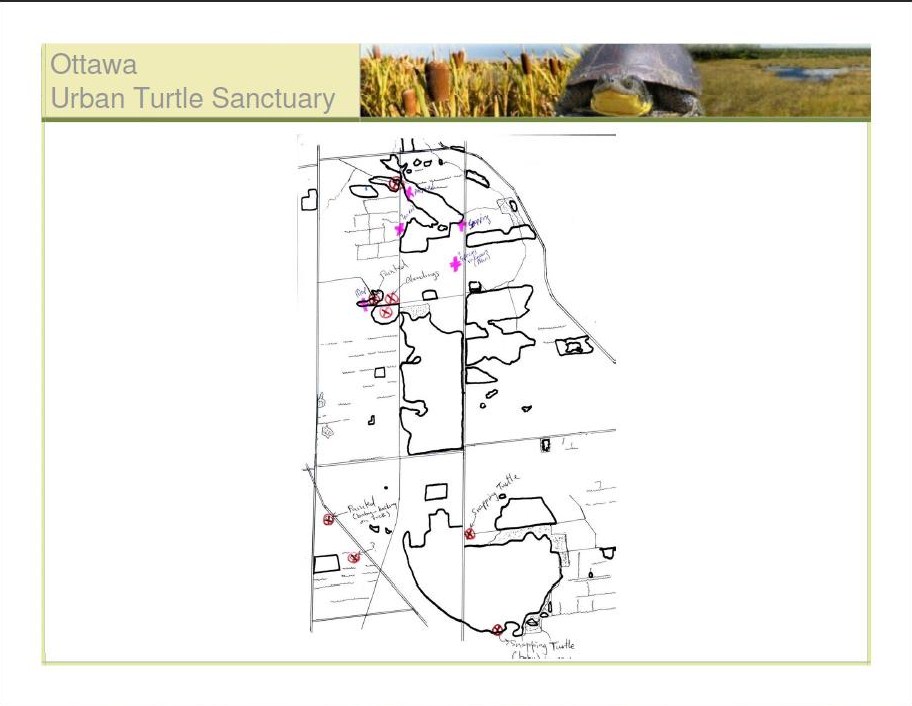
(Above map of area in between Hunt Club and Leitrim - Uplands to Bank - shows turtle sightings, etc. )
Taken from Ottawa Urban Turtle Sanctuary Presentation: Finding and fighting for road-free refuges in the National Capital Region (2008 or 2009 presentation?)
This is part of the larger Leitrim Wetland south of Ottawa - where they are building the Findlay Creek development.
Just 15 minutes south of Parliament Hill, in the nation's capital you can find the Ottawa Greenbelt. A place where the federal and municipal governments have managed to preserve local biodiversity and habitat integrity, their contribution to the future.
- Medeola Woods (Ottawa’s largest, stand of old growth trees)
- Monarch Waystation (City of Ottawa, owned)
- SAR Turtles found in wetland areas (Map, Painted and now Snapping)
Eight species of turtles live in the Province of Ontario. Four of these species live in the Leitrim wetlands. This habitat contains: Blanding’s Turtles (THR), Northern Map Turtles (SC), Painted Turtles and Snapping Turtles. While all four of these species are special, 2 of them are on the Province and Federal Species at Risk list.
With the help of the Rideau Valley Conservation Authority, the Blanding’s Turtle wetlands (Sawmill creek Tributaries 8, 9, 10) was added as part of the overall Sawmill Creek clean up crusade.
(Above map of area in between Hunt Club and Leitrim - Uplands to Bank - shows turtle sightings, etc. )
Taken from Ottawa Urban Turtle Sanctuary Presentation: Finding and fighting for road-free refuges in the National Capital Region (2008 or 2009 presentation?)
This is part of the larger Leitrim Wetland south of Ottawa - where they are building the Findlay Creek development.
Labels:
Canadian project,
ecosystem/habitat,
fauna,
green/blue corridors,
herptiles,
Ottawa,
ponds,
wetland
Thursday, April 19, 2012
get your hands dirty

Be an urban ecologist! Discover the world around you! You'd be surprised at what kind of data groups are trying to gather:
Frog Watch Ontario: amphibian monitoring program - learn the frog and toad calls online, pick your site, monitoring it once or twice a week from March to July and report your findings!
Ontario Turtle Tally (since 2003): when you spot a turtle register it online (location, type, number, habitat, etc.). You can even submit a photo and the GPS coordinates. Best time for turtle sightings is in June when they are migrating to nesting sites.
Worm Watch: this monitoring program is helping scientists determine the number and variety of earthworm species and the health of habitats. I.D. info is available online - be the first to report for Ottawa!
The Lost Ladybug Project: you can make a day out of this one - using a sweep nest and visiting various sites. Size and description of ladybugs (including photos) are needed and even "nul data" info is important to report.
Monarch Larva Monitoring Project: data collected will help with the understanding of butterfly ecology and effects on populations. Information on eggs and larva are collected either as anecdotal data or by committing to monitor a patch of milkweed for the entire butterfly season (from late spring to fall).
Images from: 1| 2| 3| 4
Monday, March 5, 2012
it's a froggy life!
Just found out about this project from the Toronto Zoo website:"Just Add Water is a U.K. national campaign to encourage the public to dig wildlife ponds, especially in urban environments. In some areas this can counteract the enormous loss of countryside ponds in recent years, and help local frogs, newts and other wildlife flourish.
One third of ponds are thought to have disappeared in the last fifty years or so and of those that remain more than 80% are thought to be in 'poor' or 'very poor' condition.
This has had an enormous impact on wildlife, particularly amphibians. Your efforts locally can make a big difference."
What a great idea!!! Check out the details including tons of info on how to build your pond here: Just Add Water!
The Canadian Wildlife Federation has also teamed up with The Pond Clinic here in Canada to create a promotional video to show how a water garden can be certified as Backyard Habitat.
And here's a great summary of key tips for your pond: Oak Leaf Gardening - Aquatic Life.
And don't forget that Save the Frog day is April 29th 2012!!
Labels:
backyard,
ecosystem/habitat,
fauna,
herptiles,
landscaping,
ponds,
website resource
Wednesday, August 10, 2011
amphibian habitat study (Ottawa)
The Geomatics and Landscape Ecology Research Laboratory at Carleton University has also done a conservation study on amphibians to determine the effect of road and land use around local ponds and the effect they have on frog and toad populations.You can read more about the conclusions of their study and the recommendations in the following online brochure.
A short summary is: Terrestrial habitat of up to 2 kms around breeding sites (ponds, wetlands and wet forests) needs to be conserved along with networks between breeding sites (corridors). Reduced traffic along roads within these boundaries is key. Both forest and open space are important to have a diverse frog and toad population in urban/suburban areas.
Labels:
Canadian project,
fauna,
herptiles,
Ottawa,
wetland
Wednesday, April 13, 2011
SLOE - Rideau River herptile survey (ottawa)
Reptile and Amphibian Survey
Sustainable Living Ottawa East is hosting its first reptile and amphibian survey along the Rideau River Nature Trail. The goal is to discover the rich diversity of reptile and amphibian species living in the community, so further action to protect these species can be taken as well as to preserve the health of the Rideau River shoreline. This event will also help SLOE build stewardship within the neighbourhood. This event will be a fun and educational experience for the whole family.
Sat May 14, 9 am - 12 pm and 9 - 10 pm.
Sat Jun 18 9 am - 12 pm and 9-10 pm.
For information and if you want to participate, contact Jess Pelow
Great summary of it here: SLOE - Surveying Our Aquatic Neighbours by Mary Trudeau
Sustainable Living Ottawa East is hosting its first reptile and amphibian survey along the Rideau River Nature Trail. The goal is to discover the rich diversity of reptile and amphibian species living in the community, so further action to protect these species can be taken as well as to preserve the health of the Rideau River shoreline. This event will also help SLOE build stewardship within the neighbourhood. This event will be a fun and educational experience for the whole family.
Sat May 14, 9 am - 12 pm and 9 - 10 pm.
Sat Jun 18 9 am - 12 pm and 9-10 pm.
For information and if you want to participate, contact Jess Pelow
Great summary of it here: SLOE - Surveying Our Aquatic Neighbours by Mary Trudeau
Labels:
Canadian project,
ecosystem/habitat,
fauna,
herptiles,
Ottawa,
urban stream/creek
Thursday, February 3, 2011
Urban Habitats (New York)

URBAN HABITATS - "An Electronic Journal on the Biology of Urban Areas Around the World"
Urban Habitats is published by the Center for Urban Restoration Ecology (CURE), a collaboration between Brooklyn Botanic Garden and Rutgers University. Articles available here on: flora, wetlands, birds, frogs, etc. It seems that a new volume of this journal is published annually in December with a full pdf of the issue available in January. However the last Volume was published in 2009.
Subscribe to:
Posts (Atom)


.jpg)