Showing posts with label mammals. Show all posts

Saturday, February 6, 2016

Urban Foxes


Finally after fifty or more years, Lebreton Flats is being redeveloped.  I've always wondered about the area and all that green space so close to the urban core.  When I was thinking how great it would be for the city to have an Urban Ecology Centre centrally located (when I started my new career in 2011) I thought something off of Bayview would be perfect.  It would be close to the river, along a major corridor (that fauna may naturally follow) and there was all that open green area.  Just a beautiful spot and vista.

I started thinking about this area again today when my friend posted about seeing an urban fox in Chinatown.

"We just saw a fox trotting at a fast clip around Primrose and Empress in Ottawa's Chinatown tonight. It looked she/he was heading towards Somerset before he/she ducked between some buildings. Who knew we'd find a fox in Centretown?"

It would be an amazing sight to see in the evening.  On the Urban Wild Walks we were told that there was a fox denning in the Macoun Marsh area (which my spouse saw this week cross St. Laurent late in the evening) and our Animal Tracks tour leader also found a fox den (although empty at the time) up in Rockcliffe Park (the official park where the pavilion is, not the neighborhood "Rockcliffe Park").  But are urban foxes common in Canada?  I knew they were in parts of the U.K. as I have read and watched documentaries on London's urban foxes.

"London is unique among western European capitals in that it has a fox population of any great size, concedes Trevor Williams, director of The Fox Project, which maintains a wildlife information bureau." (The Star, David Hewitt, 2012

"Stephen Harris, an expert on urban foxes at Bristol, says no reliable figure has ever been calculated, although he once estimated the number at 5,000 to 6,000 for London's boroughs." (L.A. Times, Christopher Werth, 2014)

London has no urban raccoon or skunk population (unlike here in Canada) but it does have increasing numbers of badgers, weasels, hedgehogs and other small nocturnal visitors.  Each creature has different territory size and the overlap of these territories may vary along with when each is on the prowl.

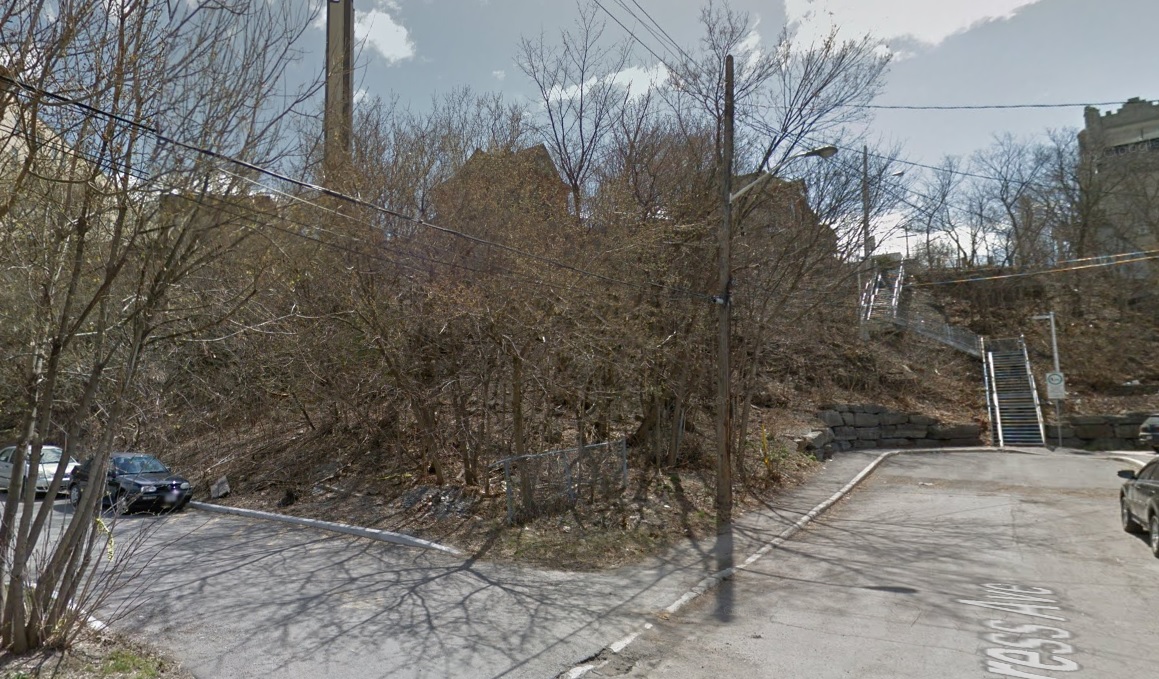
But back to Ottawa - pictured above and below are the areas that connect Lebreton Flats area to Chinatown (above the ridge) along Empress and Lorne.  There is a very scrubby areas along the ridge in both places which could offer urban mammals including foxes some cover and some easy accessible corridors to explore more urban territories above the ridge.


The pink area in the map below is the Saint Vincent hospital property and Somerset is south of this site.  The orange arrow pointing in the direction the fox was going.


Lebreton Flats (before current redevelopment started) had some great wild green and rocky areas that could offer den locations.  The fox at Macoun Marsh is found in the rocky area beside the marsh.  The den in Rockcliffe Park was dug in soil along the slopes down to the river.

Red foxes are a rare sighting but part of the reason for this is that we keep different hours.  Foxes are nocturnal like our skunk and raccoon neighbours but this still doesn't explain why they are rarely spotted here as I've definitely seen the other two creatures from time to time, so why not foxes?

They have been seen in the Fletcher Wildlife Gardens and the volunteers there estimate that there is just one family that uses the territory.  FWG's webpage indicates that despite being nocturnal, foxes will hunt during the day in the winter but this area with its fields, shrubs and woods is very different than an urban landscape. I'm guessing that urban scavenging is still best done at night when the city is more quiet.  Foxes are solitary and, even in areas where they are known to dwell, are rarely spotted.

The Toronto Wildife Centre states that foxes are more common than realized and can be found near ravine systems, large grassy fields and large parks where small mammals are plentiful (Toronto Wildlife Centre) and the MNR backgrounder states that foxes do den near human areas and are commonly found in many large urban centres in Ontario.

Charlottetown, however is one Canadian city where fox populations are similar to the London U.K. situation where "human-fox interactions are commonplace".  An urban research team studying these foxes "found 89 dens in Charlottetown". (Saltscapes)  Many residents of this city have spotted foxes - they have become a common sight unlike cities here in Ontario.

So my conclusion would be that they are more common than we realize but not as common as raccoons and skunks, which is probably a good thing!

Other great tidbits:
  • Foxes are omnivorous eating small rodents, frogs, insects, birds, snakes, acorns, grasses, corn, fruit and berries. (MNR)
  • They use abandoned groundhog burrows as dens. (Lethbridge College - the link for the LC Virtual Wildlife Project - digital Hubbard Collection is not working anymore)
  • Foxes can travel up to 10 km a day.  (Lethbridge College, Virtual Wildlife Project - Hubbard Collection)  It's 4 km from Lebreton Flats to the Fletcher Wildlife Garden.
  • They are extremely nimble - much more likes cats than dogs in this trait and can even climb trees. (FWG)
  • And let us not forget this brilliant fox who found a comfy resting spot for a morning! (#busfox)


Some other great urban mammal/wildlife posts:

Urban Crows (and supportive urbanites) (May 2011)

Helping Urban Skunks (March 2012)

Urban Coyotes (Feb 2012)

Urban Bats (June 2013 and August 2012)

Urban Fishers (Feb 2013)

Wednesday, September 30, 2015

Two Cool online resources by Nature Canada!


Found these online resources last month on Nature Canada website:

Nature Hood virtual tour:

This resource highlights all the great spots for bird viewing in the Lac Deschenes area including waterbirds, shorebirds, aerial insectivores and passerines. It provides indepth information on all the popular spots on both sides including Bates island, Baie Simard and Mud Lake!  Check it out here.

Nature Hood App:

Nature Canada is also encouraging Ottawa residents to become citizen scientists by mapping sightings of wildlife in public spaces!  This includes birds, mammals, herptiles and even insects.  It has a great glossary to help when reporting a sighting and there is also the opportunity to virtually explore the entries that are already there on the map.  This would be fun for a family outing.  Learn more by visiting the website.

And speaking about the Ottawa River - Ottawa Riverkeeper has created a virtual tour for the Voyageur Pathway.


Thursday, February 19, 2015

Time to Frog Proof your Yard this Spring (swimming pools and window wells)

From an old 2009 Ottawa Citizen Article worth repeating:
The lives of tens of thousands of frogs, toads and salamanders could be saved each year if homeowners made a few simple changes to their homes and yards, says an Ottawa biologist.  Dan Brunton said backyard swimming pools are particularly deadly, and he has found up to 10 dead amphibians in the filter of his neighbour's pool before.  "The simple thing was they just couldn't get out," Brunton said.  "There's a wonderful commercial opportunity in here. Somebody make a nice little floaty ramp. You just leave it there and the critters climb out of your pool every morning."  A green frog trapped in the filter earlier this week was luckier than most — it was still alive when Brunton visited the pool to demonstrate the problem to a CBC reporter this week. 
While Brunton was renovating his home recently, he discovered another problem for amphibians — window wells. "The day these were put in two toads were found dead the following morning," he said, pointing at his own below-grade basement windows.  Brunton has now built gravel slopes in the wells so toads and other critters can climb out — something he encourages other homeowners to do.  "Since we've put this simple, simple little ramp in there, not one more animal has died in this thing." 
Fraser Veitch, a spokesperson for Benson Pools, a company that sells pool equipment and services, said it's fairly common for frogs to get trapped in pools, but people aren't always sure what to do when it happens.

Someone has now created that device to rescue frogs (and other animals including mice) from pools called the Frog Log. Here is a You Tube video showing the product in action: Frog Log (U.S. Company)


Friday, May 2, 2014

Wildlife Construction Protocols (Ottawa)


From Ottawa Community News:

April 17, 2014

Board Looks at Alternative School Site (Kanata):

WILDLIFE PROTECTION
Measures were in place to mitigate the effects of tree cutting on birds and animals in the area, Wilkinson said.
Cutting can only be conducted until April 15, the councillor said, to avoid the nesting season of birds in the area.
If tree cutting didn't happen before the deadline for bird nesting season, there would be no way for the school to be built in time for kids to attend in September of 2015, Wilkinson said.
That tree-cutting deadline is needed to comply with the federal Migratory Birds Convention Act, Snedden wrote. In addition, KNL was asked to follow the tree-removal protocol followed by the city's forestry department. That procedure involves tree inspectors searching for evidence of animal use or habitat, which is shared with tree-cutting crews, who do a second inspection of flagged trees to see if animals are present. If there is an animal in the tree, the tree is not disturbed and the crew returns to remove it once the animal has moved on. Nesting boxes were placed around the area to lure animals such as squirrels out from trees.
A similar policy is being considered for the wildlife construction policy the city committed to drafting as part of an update to its wildlife management strategy last year.
City staff conducted surveys to identify areas where trees and wildlife habitats were to be retained, Snedden said. They also monitored cutting to ensure the removals complied with the urban tree conservation bylaw.
Snedden said Blanding's turtles are still hibernating at this time of year based on population monitoring data. Wilkinson said KNL Developments has a certificate from the province allowing it to go ahead with work because the area isn't part of the main habitat of the protected Blanding's turtles. If turtles are found, they must be protected and removed from the area, Wilkinson said.


Image from: Unpublished Ottawa

Wednesday, September 25, 2013

Bat Research

Found this on the North American Society for Bat Research Webpage:

Toronto's world famous Royal Ontario Museum (the ROM) was the location of the 2011 NASBR Teacher's Workshop in association with the annual meeting. Never before have we had such a visually stimulating site for this important event. Burton Lim and Judith Eger, NASBR members and scientific researchers, are both employed at the ROM and made all arrangements to accommodate 35 teachers for the 6-hour workshop.
 
Presentations were given on the ROM bat exhibits, Ontario bats and their biology, live bat demonstrations, an identification key exercise using museum study skins, and classroom activities using "Year of the Bat" education resources. This year's faculty included: Burton Lim, Judith Eger and Dave Ireland from the ROM; Erin Fraser, University of Western Ontario; Paul Faure, McMaster University; Andreas Streit, UNEP/Eurobats; James Eggers, Bat Conservation International; and Jacqueline Miller, University of Toronto. While faculty and teacher participants enjoyed a lovely private lunch at the ROM, they were treated to a book reading and signing, Burton & Isabelle Pipistrelle: Out of the Bat Cave, presented by the author and artist.

Images from NASBR website

Tuesday, August 27, 2013

Crucial Part of Our Ecosystem


Media Release from Orkin Pest Control Company in Regina:

"As Canadians we cherish the summer months that bring sunshine, warm weather and the urge to spend time outdoors. Inevitably, the summer season also brings pesky critters into the mix, including house flies and the dreaded mosquito.  Although these uninvited guests could put a damper on your summer plans, they all play an essential role in nature. At Orkin Canada, we believe that every pest has a place, and while not in our homes, hospitals and public buildings – they are indeed a crucial part of our ecosystem. The following lists the roles they play in the natural environment.

House Fly In Nature: Although they may bug us, flies are an essential part of the food chain. House flies have an important role in nature pollinating plants and recycling all things dead and decaying. It may not seem glamorous but flies play a vital role in assisting the decomposition of dung and decaying matter, plants or animals.

Mosquito In Nature: Mosquitoes are delicious to eat and easy to catch! Mosquitoes are the main course for multiple species including spiders, salamanders, lizards, frogs, bats, birds and multiple species of fish. Without mosquitoes of off the menu, many of these animals would lose a primary food source."

See more at: http://blogs.leaderpost.com/2013/08/20/common-critters-friends-or-foe/#sthash.32vkVtnd.dpuf

Ragnhild Brosvik Mosquito Image from Flickr under Creative Commons

P.S. Check out my latest "urban wild" nature blog: Wild. Here. (2016 update)

Thursday, August 22, 2013

Abandoned Mines and Bats (Ontario)

Found this on the Science North website:


WHY have an Abandoned Mines and Bat Workshop?           
  • Provide information on the mitigation measures available to mining companies that have abandoned mines on their properties
  • Demonstrate the importance of abandoned mines as hibernating sites for several species of bats
  • Explore what remote sensing instruments are required to survey bats, and how these instruments are used
  • Demonstrate how to ‘Bat Gate’ an abandoned mine
  • Address the safety concerns surrounding abandoned mine sites
  • Inform participants about White-nose Syndrome (alien fungus), a recent threat to hibernating bats
  • Provide each participant with a video documentary on “Abandoned Mines and Bats” post conference
Why Mining Companies Should Become Involved?
  • Mining companies will increase their knowledge on ‘mitigating measures’ for abandoned mine.
  • ‘Bat gates’ are an effective way to protect bats in abandoned mines and keep people out.
  • The technology used to monitor bats and the information collected is easy to access, even by non-scientists.
  • Mining companies can be proactive at protecting bat species by identifying abandoned mines used by bats.

Thursday, June 20, 2013

Urban Bats (Ottawa)


We'd love to know more about this event held at the end of May at Macoun Marsh.  We had heard that they were going to use sonar to record the bats and determine what species could be found but if it was bat tagging - that would be a whole other level!

From St. Laurent Academy Blog: Bat research scientist Brian Hickey (St. Lawrence River Institute of Environmental Sciences) will join us on Thursday, May 30 from 7:30 pm to 9:15 pm to search for Hoary and Little Brown Bats!  COME JOIN US AT MACOUN MARSH!  Mr. L.

From Biodiversity Matters Blog: We had a bat and night critters evening at the Macoun Marsh. Bat research scientist Brian Hickey (St. Lawrence River Institute of Environmental Sciences) came out to search for Hoary and Little Brown Bats. Both were recorded.

From Pub Patio Playdate: The man accompanied little one’s preschool class on a field trip to the Macoun Marsh last week and had an awesome time. A few days later he attended a bat-tagging excursion at the marsh and he can’t wait to spend more time exploring the area’s rich biodiversity. I had to miss the field trip but am looking forward to checking this place out soon.


Update August 2013: Bat research continues at Macoun Marsh.

**********************

(Friends of Gatineau Park had a Bat Night in June, where Rachel Hamilton, a graduate alumni from the University of Western Ontario, provided insight into bats, from the most unusual to those that can be found in backyards. She also discussed how researchers are able to study these flying friends and shared how bats impact on people's daily lives.)

The MNR has an educational Bat Fact Sheet which is part of their "Living With" series.

Monday, February 18, 2013

urban fisher study (Albany, New York)

Study done by Scott Lapointe and Roland Kayes

From News Article:  "This winter I’m on the track of an urban weasel in Albany — the fisher. These six-to-13-pound members of the weasel family started moving into urban areas 10 years ago, and have been quietly hunting their squirrel and rabbit dinners here ever since... we got our first camera-trap photograph of an Eastern fisher moving through suburban Albany (in 2000). In a century the Northeastern fisher had gone from wilderness animal to suburban predator...

Our approach is to document the ecology and behavior of fishers living in the urban forests of the Capital District, a triangle of suburban development with Albany, Schenectady and Troy, N.Y., as its points. In particular, we want to see how the animals move through and connect the small forest fragments, avoiding speeding cars and still finding enough food. We will then contrast this with what we find in a population of “wild” fishers living about 20 miles away in the forests around Grafton Lakes State Park and Pittstown State Forest."

The urban study site has four times the density of roads and 15 times the population density of the wild site.

Full article & pictures from the New York Times 

Also check out further articles on their Fisher Studies

P.S. Check out my latest "urban wild" nature blog: Wild. Here. (2016 update)

Sunday, February 10, 2013

our impact on the wild

The pros and cons of promoting "urban wild"...

We live near Green's Creek and had seen an owl very close to the foot path (but couldn't i.d. it as it flew off quickly - as surprised to see us as we were to see it) this fall, so I was excited to see this picture on The Weather Network's page: Great Grey Owl.  It was a nice confirmation that we are blessed to live so close to an area that is great habitat for wildlife.

We missed this write up in the Ottawa Citizen: Return of the Great Grey Owls which should have been a great opportunity for promoting interest in wildlife to city dwellers but then I saw some comments on the Ottawa Field Naturalists' page and discovered this blog post: The debate on baiting owls by 100 Birds in a Year.  I'm not currently in town, so had no idea that this was happening.

This issue distressed me.  I know it is nature's way - that owls are predatory but I feel that baiting owls is not natural for either the mouse or the owl and I just feel bad for both. I didn't want to write about it but when I stumbled upon this posted by Tony Beck, I felt it sums up the situation quite well and provided some guidelines to consider: Interaction with Owls at Tommy Thompson Park.

"An owl should not be focused on you: it should either be sleeping with its eyes closed on focusing intently on prey. If you see an owl exhibiting these sings, simply back off and give it space.Considering the stress that one individual can place on an owl, it is easy to see how problematic it can be when the location of an owl is posted or shared by word of mouth. It isn’t long before the owl is being bombarded by multitudes of people."

At the above link there is a pdf document that outlines their new Viewing and Reporting Policy.  These types of policies should be enacted in all cities - I hope that Ottawa follows suit.

I also feel that education is key so that people understand their impact on the wild and know how to interact and read the signs that are indicated by the wildlife species themselves. Perhaps at some point - depending on the situation certain locations will have to be protected and in others "limited weekend guided tours" could be allowed.  For now I'm hoping that policies such as the ones above will prove helpful.  If I had known about the Green's Creek situation, I would have truly appreciated having a number I could call and some local authorities that could have dealt with the situation properly.

No Image Included as a Solidarity Action for the Owls

Sunday, February 3, 2013

purchase of four pairs of squirrels (London)


Information from City of London (Ontario) park signage: Victoria park's large squirrel population is not native; it originated with the purchase of four pairs of squirrels in 1914.  Others were added in subsequent years.

Saturday, January 19, 2013

Thursday, November 8, 2012

urban wildlife (Ottawa)


Amy's picture of the Eastern Redback Salamander found in Rockcliffe Park reminded me of other great nature sightings in the city:

Eric Darwin, blogger of West Side Action posts some great pictures of animals in his blog, as he's an active cyclists and pedestrian.  Some of his nature photos include turtles basking, comorants on the Ottawa River and beavers in lebreton flats.  The two I've included here are a snake along the bike path and a great blue heron on the Rideau Canal.

Also Fernando Farfand who is active on Flickr managed to capture the deer in Rockcliffe Park, the same year, my partner and I saw it (but only managed to get a blurry photo of its rear!).  Another photographer on Flickr had some great pictures of the prolific rabbits in Major's Hills Park.

What type of urban wildlife have you seen this fall?


Saturday, August 18, 2012

Urban Bat Visitors


Interesting information on the urban population of bats:

- Bats can slip through openings the size of a dime, so identifying their entry points is tricky. They usually find their way in through chimney tops, vents, open doors or windows, broken screens, eaves and loose roof shingles.

- Warm weather drives bats from colonies within upper walls and attics to lower areas in houses.  During the daytime, bats sleepwalk down the spaces behind interior walls, later finding openings leading into houses’ living spaces where they fly about in confusion.

- Urban bat colonies tend to be quite small while buildings in rural areas can have populations that number in the hundreds. Rural populations are higher because of access to insects.

- A single bat can eat three times its weight in insects every night.

- This summer animal wilflife control companies in the area say calls for help soared in the recent heat wave  (more than 100 calls a day).

- The explosion of calls is also likely related to worries over a recent warning from the city’s health department that a dead bat in the Ottawa area was found to have rabies.

- Most of the bats are non-migratory big brown bats whose urban populations seem not to have been decimated by white-nose syndrome (WNS), a deadly fungal disease that has killed millions of mostly smaller bats in Canada and the U.S.

Information from Ottawa Citizen Article:
http://www.ottawacitizen.com/health/Long+summer+brings+bats+home+roost+Ottawa/7073879/story.html

Image from: EKU Working Group


***************

For more information there is also a great post on a Big Brown Bat visitor on Seabrooke Leckie's Blog - The Marvelous in Nature.

The Royal Ontario Museum has a "Listen to the Night: Bats of Ontario" exhibition that can be rented which covers the following topics:   Diversity, Health, Hibernation,  Summer Roosts, Cave Roosts,  Attic Roosts, Tree Roosting, Flight, Senses,  Echolocation,  Conservation and Current Research.

Monday, July 23, 2012

Emergant Plant Installation (Ohio)


From University of Toledo (Ohio):

"Using plant plugs to vegetate the banks of the Ottawa River. The transition zone between normal high and low water is devoid of plants.  We are working on selecting native species to inhabit this zone."

The plants that they are using include:
- Water Willow (Justica americana)
- Buttonbush (Cephalanthus occidentalis)
- Emory's Sedge (Carex emoryi) - video on this plant
- Prairie Cordgrass (Spartina pectinata)
- Bald Spikerush (Eleocharis erythropoda)
- Hairy Sedge (Carex lacustris)
- Gray's Sedge (Carex grayi)

Another really cool video from them:  Indiana Bat Survey

Wednesday, July 11, 2012

bats + golf = hole in one


Saw this on the Weather Network earlier this year - thought it was such a great idea:

"Golf Courses Look to Bat Houses to Help Control Mosquito Population"


May 12, 2012 — Staff Writers — The last distraction any golfer needs on the course is those pesty mosquitoes. Now, several golf courses across Vancouver are hoping bats can help control those little blood-suckers.


More info here: The Weather Network

Image from The Weather Network

Wednesday, March 28, 2012

our disposable trash and the wildlife that gets caught

Last month Furbearer Defenders wrote a post about the issue of skunks getting their head caught in the drainage holes of dumpsters. This week I also found some links to skunks who had gotten their head trapped in various jars and cups.

"It's not unusual for skunks to get their heads stuck in random objects — they are easily attracted to food smells and because their heads are triangular in shape, it is easy for them to push through narrow openings." (CBC Skunk Story)

"Skunks won’t spray you if they can’t see you, so it’s not a risk to grab the cup and pull it off. Skunks are nearsighted. They see the world in slow-moving blobs. Simon said the trick is to move slowly and speak in soft, soothing tones to the skunk - they stomp their feet before they spray.

The best way consumers can prevent a similar skunk emergency is to thoroughly rinse and cut up containers before discarding/disposal: Raccoons get their heads stuck in peanut butter jars, birds get caught in 6-pack can holders and trash poses other risks for wildlife, said Simon. (New Haven Register Skunk Story)

What a good reminder of how we can help wildlife:
- wash and clean all recyclables well before they are put out in recycling bin
- cut and/or crush all plastic so that it can't get trapped around an animal
- keep all garbage will secured and in a pail with lid
- put out garbage/recyclables the day of collection so that nocturnal animals can't get at your containers
- if you see garbage on the street, in ditches or parks pick it up and dispose of it safely
- if possible don't use disposable cups at all (especially ones with rounded lid & large hole on top!)
- the upside down Yoplait yogurt containers (in the U.S.) are especially dangerous for skunks.

The wildlife will thank you!

*****************************

*All skunks pictured in this post were rescued and jars, cups removed.

News Reports:

- Animal Rescue - Brewster Police

- Stuck Skunk - KTLA

- Birdwatchers Save a Life

Monday, February 13, 2012

urban coyotes


During our tracking class last week, the teacher pointed out fresh coyote tracks on school grounds beside the loggersports field. The campus used to be an old farm and there is a river running on the east and south end, with a small creek running into it. Rabbit, skunk, squirrels and racoons live near or on the property. We've also been told that you can find many different birds including osprey, cooper's hawks, ruffed grouse and owls. When you really think about it, it's amazing who our neighbours are.

In the last couple of years there has been a growing number of human-coyote interactions in different cities across Canada and municipalities have had different approaches to addressing these "conflicts". Vancouver has chosen a policy of "co-existance" which many wildlife centres have praised as forward-thinking. I received an email from the Ottawa-Carleton Wildlife Centre that had this to say:

"In the metropolitan core (Vancouver, Burnaby and New Westminster) there are about 200 to 300 coyotes. Coyotes in urban areas will scrounge for food scraps and pet food left outdoors in garbage or compost — but their main food source in cities are the large populations of rats and mice.

Co-Existing with Coyotes
aims to reduce conflict between people, pets and coyotes by providing accessible information through a wide range of media. The program has been developed in cooperation with the Vancouver Park Board and BC's Ministry of Environment in response to increasing public contact with, and demand for information about, coyotes in Vancouver."


Check out their website or email them to find out more: coyotes@stanleyparkecology.ca

Saturday, July 16, 2011

bears in urban areas


Bear and Human Interaction:

"People often mistake a bear clacking his jaws as threatening, but he is really saying "get out of here, leave me alone and don't hurt me," Stringham said.

Non-threatening behaviour and sensitivity to body language usually defuses the situation, he said.

Some cities are now ensuring there is a green corridor so lost wildlife can be escorted out of town, he said."


Read more here.

To study or to act:

"Still, $3 million (for a bear census on Kenai Peninsula) would buy a lot of bear-resistant garbage cans and fund a significant outreach campaign to educate the public about decreasing bear attractants. That may be a better use for the money, Selinger said. As much as he’d like to have an answer when people ask how many bears there are on the peninsula, he’s hesitant to be enthusiastic about a census without knowing how valid that result would be."


From the Redoubt Reporter.

Photo Credit: Larry Lewis, Alaska Department of Fish and Game

Saturday, December 11, 2010

our bucktoothed neighbour


You may have heard the news this summer, that there were some beaver attacks on dogs in a Red Deer park. What was really heartening was that the dog owners did not side with the City and demand that the beavers be killed - there seemed to be some degree of appreciation for wildlife which was great. Unfortunately this story didn't end well, with one beaver being shot (by a lone vigilante?) but in the end the City changed its stance:

"the City of Red Deer will not remove or relocate the park's six to 12 beavers, because no beaver attacks have been reported since the weekend, said Trevor Poth, the city's parks superintendent.

"We see no need to trap or relocate any beaver at Three Mile Bend at this time," Poth said in a news release. "We will, however, continue to monitor the situation at the park and educate park users."

The city has installed more signs in the park warning people of aggressive wildlife and reminding dog owners to maintain control over their pets in the off-leash park."


The Humane Society of the United States (HSUS) has a great resource on their website providing information on a little over twenty "wild neighbours" that we may encounter in urban areas. The beaver is one of those neighbours. This is a great place to learn more about these impressive creatures!

In Ottawa, the Ottawa Carleton Wildlife Centre can help people with beaver conflicts. An article in their Spring 2010 newsletter, details how they worked with concerned neighbours in the Graham Creek area who wanted to learn how to live with the beavers rather than trap and get rid of them. The OCWC has also worked with Fletcher Wildlife Garden to help overwinter a visitor in their pond.

The Fur Bearer Defenders (located in Burnaby) also has a campaign to help beavers:

"The main goals of our beaver campaign are to:

a) encourage local municipalities to replace cruel trapping with non-lethal alternatives
b) encourage city councils to pass legislation to prohibit cruel traps
c) raise awareness of the benefits of beavers in our ecosystem"


** Flickr photo by Keith Williams