Showing posts with label backyard. Show all posts

Tuesday, March 15, 2016

More about SNAP - Lake Wilcox (TRCA - Toronto)

Great examples of front yard landscaping that helps with biodiversity, stormwater runoff and xeriscaping.  (Wish they had some estimates of costs - that would be great to know about!)

From SNAP - Lake Wilcox:

Two Front Yard Makeover demonstration projects were installed in July-September 2012.

These projects play an essential role in communicating the objectives of SNAP and profiling many of the key practices of residential eco-landscaping.

Regarding the new gardens - noted comment from a neighbour was ‘Environmentally friendly garden yet artistic and multi-use’.

Both watered, on average, once a week using only water from the rain barrel, no potable water was used. Neither design includes a lawn, thus both time and water were saved.

BEFORE:


AFTER:


 BEFORE:


AFTER:


Photos from SNAP website.

Some details:

  • Roof leader discharges to a bioswale or soak away underlain with AquaBlox units.
  • Discharge of another roof leader into a rain barrel with overflow directed to a dry river bed that leads to a soakaway or rain garden.
  • Discharge of a third downspout onto a permeable driveway/walkway.
  • Water efficient native plantings of trees, shrubs and plants.


Link to SNAP Lake Wilcox Project Page.

What is SNAP?


Saturday, February 6, 2016

Urban Foxes


Finally after fifty or more years, Lebreton Flats is being redeveloped.  I've always wondered about the area and all that green space so close to the urban core.  When I was thinking how great it would be for the city to have an Urban Ecology Centre centrally located (when I started my new career in 2011) I thought something off of Bayview would be perfect.  It would be close to the river, along a major corridor (that fauna may naturally follow) and there was all that open green area.  Just a beautiful spot and vista.

I started thinking about this area again today when my friend posted about seeing an urban fox in Chinatown.

"We just saw a fox trotting at a fast clip around Primrose and Empress in Ottawa's Chinatown tonight. It looked she/he was heading towards Somerset before he/she ducked between some buildings. Who knew we'd find a fox in Centretown?"

It would be an amazing sight to see in the evening.  On the Urban Wild Walks we were told that there was a fox denning in the Macoun Marsh area (which my spouse saw this week cross St. Laurent late in the evening) and our Animal Tracks tour leader also found a fox den (although empty at the time) up in Rockcliffe Park (the official park where the pavilion is, not the neighborhood "Rockcliffe Park").  But are urban foxes common in Canada?  I knew they were in parts of the U.K. as I have read and watched documentaries on London's urban foxes.

"London is unique among western European capitals in that it has a fox population of any great size, concedes Trevor Williams, director of The Fox Project, which maintains a wildlife information bureau." (The Star, David Hewitt, 2012

"Stephen Harris, an expert on urban foxes at Bristol, says no reliable figure has ever been calculated, although he once estimated the number at 5,000 to 6,000 for London's boroughs." (L.A. Times, Christopher Werth, 2014)

London has no urban raccoon or skunk population (unlike here in Canada) but it does have increasing numbers of badgers, weasels, hedgehogs and other small nocturnal visitors.  Each creature has different territory size and the overlap of these territories may vary along with when each is on the prowl.

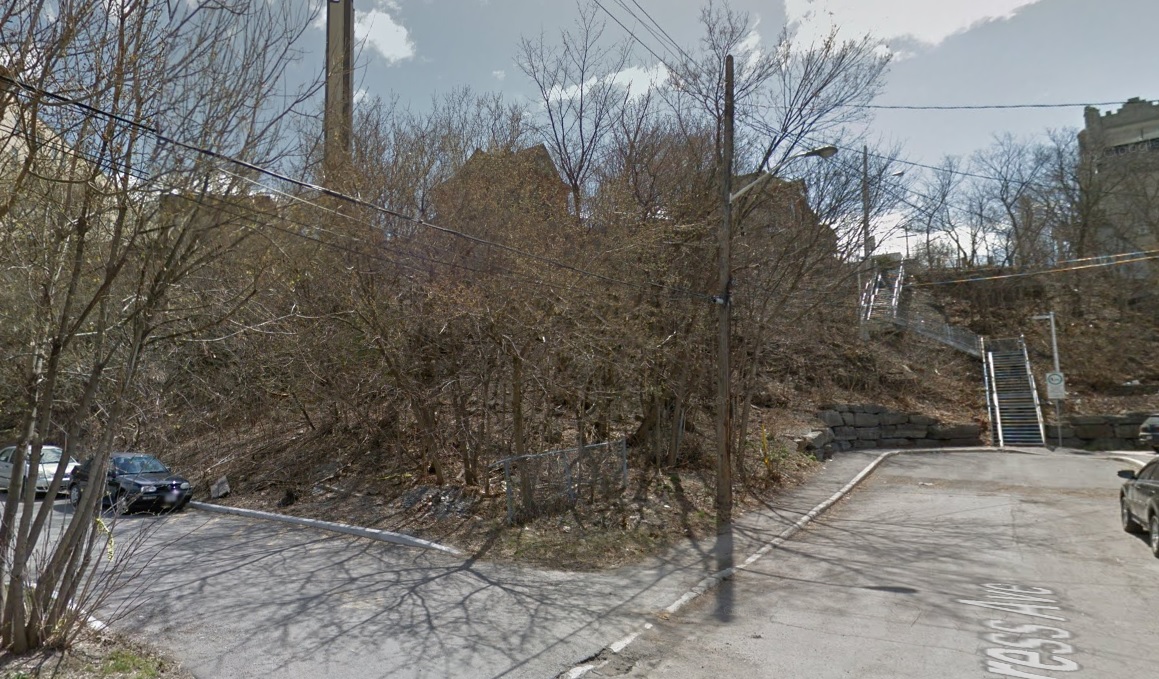
But back to Ottawa - pictured above and below are the areas that connect Lebreton Flats area to Chinatown (above the ridge) along Empress and Lorne.  There is a very scrubby areas along the ridge in both places which could offer urban mammals including foxes some cover and some easy accessible corridors to explore more urban territories above the ridge.


The pink area in the map below is the Saint Vincent hospital property and Somerset is south of this site.  The orange arrow pointing in the direction the fox was going.


Lebreton Flats (before current redevelopment started) had some great wild green and rocky areas that could offer den locations.  The fox at Macoun Marsh is found in the rocky area beside the marsh.  The den in Rockcliffe Park was dug in soil along the slopes down to the river.

Red foxes are a rare sighting but part of the reason for this is that we keep different hours.  Foxes are nocturnal like our skunk and raccoon neighbours but this still doesn't explain why they are rarely spotted here as I've definitely seen the other two creatures from time to time, so why not foxes?

They have been seen in the Fletcher Wildlife Gardens and the volunteers there estimate that there is just one family that uses the territory.  FWG's webpage indicates that despite being nocturnal, foxes will hunt during the day in the winter but this area with its fields, shrubs and woods is very different than an urban landscape. I'm guessing that urban scavenging is still best done at night when the city is more quiet.  Foxes are solitary and, even in areas where they are known to dwell, are rarely spotted.

The Toronto Wildife Centre states that foxes are more common than realized and can be found near ravine systems, large grassy fields and large parks where small mammals are plentiful (Toronto Wildlife Centre) and the MNR backgrounder states that foxes do den near human areas and are commonly found in many large urban centres in Ontario.

Charlottetown, however is one Canadian city where fox populations are similar to the London U.K. situation where "human-fox interactions are commonplace".  An urban research team studying these foxes "found 89 dens in Charlottetown". (Saltscapes)  Many residents of this city have spotted foxes - they have become a common sight unlike cities here in Ontario.

So my conclusion would be that they are more common than we realize but not as common as raccoons and skunks, which is probably a good thing!

Other great tidbits:
  • Foxes are omnivorous eating small rodents, frogs, insects, birds, snakes, acorns, grasses, corn, fruit and berries. (MNR)
  • They use abandoned groundhog burrows as dens. (Lethbridge College - the link for the LC Virtual Wildlife Project - digital Hubbard Collection is not working anymore)
  • Foxes can travel up to 10 km a day.  (Lethbridge College, Virtual Wildlife Project - Hubbard Collection)  It's 4 km from Lebreton Flats to the Fletcher Wildlife Garden.
  • They are extremely nimble - much more likes cats than dogs in this trait and can even climb trees. (FWG)
  • And let us not forget this brilliant fox who found a comfy resting spot for a morning! (#busfox)


Some other great urban mammal/wildlife posts:

Urban Crows (and supportive urbanites) (May 2011)

Helping Urban Skunks (March 2012)

Urban Coyotes (Feb 2012)

Urban Bats (June 2013 and August 2012)

Urban Fishers (Feb 2013)

Tuesday, January 26, 2016

SNAP Eco-Landscaping: Program and Information Guide


From their website:
The Sustainable Neighbourhood Retrofit Action Plan (SNAP) is an innovative pilot program led by Toronto and Region Conservation (TRCA) in collaboration with many municipal and community partners. The SNAP program aims to accelerate the implementation of environmental improvements and urban renewal at the neighbourhood scale. It takes an integrated approach to overcome urban retrofit challenges and address a broad range of objectives with locally tailored solutions. Each SNAP neighbourhood features unique initiatives to inspire residents, businesses and governments to take action. 
In partnership with local stakeholders including residents, businesses, local groups and institutions, the project seeks to develop action plans to improve the local environment on the neighbourhood scale and build resiliency against climate change by greening local infrastructure and encouraging positive behavior changes among residents. Based on existing conditions of each neighbourhood the project sets neighbourhood-level targets and identifies key actions on private and public property to address environmental objectives in the context of social and economic considerations for each neighbourhood. Each plan builds the business case for implementation by measuring individual and community benefits and cost savings.
http://sustainableneighbourhoods.ca/wp/eco-landscaping-how-to-information-and-garden-designs/

Thursday, February 19, 2015

Time to Frog Proof your Yard this Spring (swimming pools and window wells)

From an old 2009 Ottawa Citizen Article worth repeating:
The lives of tens of thousands of frogs, toads and salamanders could be saved each year if homeowners made a few simple changes to their homes and yards, says an Ottawa biologist.  Dan Brunton said backyard swimming pools are particularly deadly, and he has found up to 10 dead amphibians in the filter of his neighbour's pool before.  "The simple thing was they just couldn't get out," Brunton said.  "There's a wonderful commercial opportunity in here. Somebody make a nice little floaty ramp. You just leave it there and the critters climb out of your pool every morning."  A green frog trapped in the filter earlier this week was luckier than most — it was still alive when Brunton visited the pool to demonstrate the problem to a CBC reporter this week. 
While Brunton was renovating his home recently, he discovered another problem for amphibians — window wells. "The day these were put in two toads were found dead the following morning," he said, pointing at his own below-grade basement windows.  Brunton has now built gravel slopes in the wells so toads and other critters can climb out — something he encourages other homeowners to do.  "Since we've put this simple, simple little ramp in there, not one more animal has died in this thing." 
Fraser Veitch, a spokesperson for Benson Pools, a company that sells pool equipment and services, said it's fairly common for frogs to get trapped in pools, but people aren't always sure what to do when it happens.

Someone has now created that device to rescue frogs (and other animals including mice) from pools called the Frog Log. Here is a You Tube video showing the product in action: Frog Log (U.S. Company)


Thursday, February 12, 2015

Sustainable Option for Garden Path


Brilliant sustainable landscaping idea by local company Moneca Kaiser Design Build.

An outdoor mosaic pathway using off-cuts from a local granite company.  Close-up below.

All photos by MKDB.


Wednesday, December 10, 2014

ASLA's video on "Designing Neighbourhoods for People and Wildlife"


This is one of the American Society of Landscape Architects' videos in a series called "Sustainable Landscaping".  Other topics include:
  • Building a Park Out of Waste
  • Designing for Active Living
  • The Edible City
  • Energy Efficient Home Landscapes
  • From Industrial Wasteland to Community Park
  • Infrastructure for All
  • Revitalizing Communities with Parks
  • Leveraging the Landscape to Manage Water
  • Urban Forests = Cleaner, Cooler Air
The webpage also provides reasons to consider wildlife design and benefits from this type of design for both people and wildlife.

It's great to see this association promoting a different approach to landscaping both public and private yards.  Hopefully more and more graduates of landscape architecture will make Native and Sustainable Landscaping a priority when working with clients!

Check it out here: ASLA: Sustainable Landscaping

Friday, November 7, 2014

For your Ottawa lanscaping needs (locally grown plants)

Here are two local Ottawa businesses that have started through the Just Food Start Up Farm Program
that sell landscaping plants: flowers, shrubs and trees:

Barefoot Gardens

Products: non-certified organic seedlings, mixed vegetables, herbs, and flowers.

Contact: Randi Townsend & Sarah Lawrance
Website:  www.facebook.com/barefootinthegardens

Twigs Nursery: Native Trees and Edibles

Products:
- potted seedlings from broadleaf trees (sugar maple, mulberry, walnut, oak & hickory)
- conifers
- various shrubs (winterberry, highbush cranberry)
- wild small fruit (raspberry, dewberry)

Field-grown and container-grown seedlings are available in 1-gallon and larger sizes, grown from wild seed using organic practices.

Contact: Catherine Copp
Website: www.twigsnursery.com

Wednesday, July 23, 2014

Slow Spread Sink (Sonoma Valley)


Best land management practices for storm water runoff.

The idea is to slow water runoff down - permeable surfaces work better and this can be applied not only to the ground but also roofs (that have impermeable surfaces).  Spread it around via rain barrels, french drains and other methods such as vegetated slopes and various gardens.  You don't want water to immediately be directed to pipes and culverts off your property.  Finally: let it sink!  Water can erode if there is not enough greenscaping - bare ground can be an issue just like pavement.  Use gravity, include swales and rain gardens and provide some xeriscaping on higher grounds.

This guide by Sonoma Valley on beneficial stormwater management is very comprehensive and provides lots of tips to homeowners and landowners.


Monday, May 19, 2014

Grasses and Grass-scapes


Talk Offered December 2008:

"Grasses and Grasscapes: From the Four Corners of the Earth to You, A Talk by Dave Demers"

Dave Demers, a modern day plant hunter and garden designer, delighted his audience with his sumptuous photographs of grasscapes in the wild, and in cutting-edge gardens.

Mr. Demers, who has traveled the world to discover plants in their native habitats, outlined and described the best grass cultivars for our northern landscapes.

Dave currently owns Cyan Horticulture, a design-build landscape company in Vancouver.

www.cyanhorticulture.com

(reposting because there are such cool gardens pictured on his blog!)

Tuesday, April 15, 2014

backyard birds (Toronto)


"On a cool and foggy morning, after a night of rain, the birds are staying put and feeding. It makes for fine listening, not only to the avian newcomers but also to the familiar urban birds — cardinals, chickadees, red-winged blackbirds, goldfinches and house finches."
From Toronto Star Article: Songbird ‘superhighway’ runs through Toronto as 50 million will fly over in spring migration  By: Leslie Scrivener, May 2012

Image from Wild Birds Unlimited East Lansing

Friday, April 11, 2014

native flowers for your garden...


Plant these now for year-round benefits for wildlife - from NWF:

Coneflowers: Nine native coneflower species grow from across the eastern and central Lower 48 to the Rocky Mountain states. The plants produce large flowers with sturdy orange-bronze “cones” at the center. During the cold months, goldfinches perch on or just below the blackened winter cones to pluck out the seeds.

Sennas: In many areas of the country, two native species—American senna and Maryland senna—bear a profusion of flowers in mid- to late-summer, followed by long, drooping seedpods. They provide shelter as well as chocolate-colored seeds that offer nutritious winter meals for songbirds and wild turkeys and other game birds. When in flower, sennas are magnets for certain native bees and butterflies. They also serve as host plants for cloudless sulfur butterfly caterpillars.

Round-head bush clover: Native to areas in the eastern two-thirds of the country, this plant is not particularly showy but it is robust and beneficial for wildlife. Its bronze seed heads decorate the winter garden and provide food for songbirds and game birds. Neil Diboll, president of Prairie Nursery in Westfield, Wisconsin, calls round-head bush clover “an excellent late-season ‘emergency food’ for birds.” The plant grows 3 to 6 feet tall, he points out, “so the seeds are elevated above even deep snow cover that obscures lower-growing plants and their fruits.”

Other good winter seed sources: Depending on where you live, these may include asters, black-eyed Susans and late-blooming native sunflowers. Unless you have room in your garden for them to spread, avoid sunflower species that increase rapidly by rhizomes or that are prolific self-sowers.

• Flat-topped white aster (Umbellate aster): "Easy to grow, looks great in a garden (toward the back as it's 4 feet tall), spreads nice and slowly, and doesn't make a mess. And great for butterfly gardens - butterflies like plants with flat clusters of flowers and asters are the host plant for painted lady butterflies." Sandy Garland - Fletcher Wildlife Garden Ottawa

Monday, April 7, 2014

start planning your backyard for spring!


From World of Birds, Ottawa Citizen written by Elizabeth Le Geyt (2007):

"Birds like moderately untidy gardens with tangly corners, secure sites for well-hidden nests. Cedars and other conifers provide hiding places and shelter. Many species of dogwood have berries for fruit-eating birds like robins and waxwings. Honeysuckle fruits early in the summer and many species of crab-apple trees hold their apples throughout the winter.

It will soon be time to select perennial flowering plants, berry-bearing shrubs and annual flowers attractive to hummingbirds and butterflies. Red flowers, like monarda (bee balm), phlox, fuchsia and heuchera (coral bells), are perennials beloved by hummingbirds. Annuals like salvia, petunias, geraniums and other colourful flowers will attract both hummingbirds and hummingbird hawk moths.

Water, a necessity for all living creatures, should be provided. If you have room, a pond is ideal.

Smaller lots can have a bird bath or even large clay saucers. Ponds can be a haven for frogs and dragonflies that are disappearing at an alarming rate due to the pollution of natural water areas. If you stock your pond with fish, you may even attract a great blue heron, or a kingfisher! Bird houses for cavity nesting birds and a bird feeder complete a wildlife friendly, chemical-free habitat."

Also keep in mind that there may be bee-killing pesticides on those annuals you buy!

Image from "Gardening Gone Wild" blog

Sunday, March 16, 2014

wish I could go to this event on moss

Moss likes your garden! Why you might consider taking its side    

Monday, March 17, 2014, 7:30 p.m.sharp

Jennifer Doubt, Chief Collections Manager, Botany Section at the Canadian Museum of Nature, will share with us what moss is and how it fits in the plant world.


Presented by the Gloucester Horticultural Society, 4373 Generation Court.

Pre-registration recommended at (613) 749-8897.


Free Admission.


For more information:

Contact Name: Fleurette Huneault
Website: http://www.gardenontario.org/site.php.glouster
Phone: 613-749-8897
E-mail: gloucester (at) gardenontario.org


Tuesday, January 28, 2014

Habitat Stepping Stones (Australia)

Link to a new project from the Australian Research Institute for Environment and Sustainability (ARIES) at Macquarie University, which is seeking to enhance the complexity of urban biodiversity.  The website provides information to urban citizens about how to help out wildlife who are "doing it tough".

Individuals pledge to provide three or more "stepping stones" (schools and community centres can participate also) and then the address can be added to an online map so illustrate the number of stepping stones across the city.  Participants can also share stories, photos and videos through social media.

Three cities are already participating: Sydney, Melbourne and Adelaide.

Discounts and/or free plants are available to participants at their local garden store, who also receive a sign to put up in the front of their home.  They also received local wildlife tips and news.

All details here: Habitat Stepping Stones

Sunday, January 12, 2014

National Tree Benefit Calculator


This is the wonderful tool that I used to calculate the ecological benefits of the trees at Rockcliffe Lands for my Spacing Ottawa article.  It was conceived and developed by Casey Trees and Davey Tree Expert Co and is based on  i-Tree’s street tree assessment tool called STREETS.

From the website:
The National Tree Benefit Calculator allows anyone to make a simple estimation of the benefits individual street-side trees provide. With inputs of location, species and tree size, users will get an understanding of the environmental and economic value trees provide on an annual basis. The Tree Benefit Calculator is intended to be simple and accessible. As such, this tool should be considered a starting point for understanding trees’ value in the community, rather than a scientific accounting of precise values. 
While in theory this tool can only be used in U.S. you can adapt it for Southern Ontario by choosing the most northerly hardiness zone (Northeast Zone).

For more information on the benefits of urban street trees, take a look at this video from i-Tree:

Community Trees: A Living Asset


Friday, January 3, 2014

Wildflowers of Detroit (Kickstarter Project)


Found this great kickstarter project from 2011.  They wanted to do ground source mapping of the return of wildflowers to the City of Detroit due to the increase of abandoned lots.  How interesting!!

Here is an Huffington Post article on the project: Wildflowers of Detroit Smartphone App

More information from the website:

Wildflowers of Detroit ??

One pervasive vision of Detroit is its ruins - the monolithic hulks of an industrial era gone by, documented in striking photographs and tales of urban exploration. Missing from this narrative is the other side of the coin.  In place of those decaying buildings grow plots of wildflowers and wildlife. After knowing these secret gardens and hidden blooms, we feel this crucial story needs to be told.  Thats where you come in.  Wildflowers of Detroit is a community technology project for cataloging wild plants growing in Detroit, an effort which can enable people's appreciation of its open space.  Though experiencing and appreciating the "empty" fields, we can discover together the emerging ecology of this area.  Our technologies collaborative WinterRoot is teaming up with Detroit's Omnicorp Hackerspace and Alley Culture's Seed Exchange to bring this vision into being.
A link to one of the creators Tumblr Site.


All Images from Wildflowers of Detroit

Thursday, September 19, 2013

Placemaking - the value of green urban areas (Ottawa)

The Power of a Small Green Place

- A Case Study of Ottawa's Fletcher Wildlife Garden by Renate Sander-Regier

Abstract: The Power of a Small Green Place is an ethnographic case study among the volunteers and urban wilds of Ottawa’s Fletcher Wildlife Garden (FWG). Through the conceptual lens of the geographical concept of place – with its wide range of physical, relational and deeper meaningful considerations – this urban wildlife habitat project emerged as a place of profound significance. Volunteers working to create and maintain the FWG’s diverse habitats benefit from opportunities to engage in physical outdoor activity, establish social connections, make contact with the natural world, find deep personal satisfaction and meaning, and experience healthier and mutually beneficial relations with nature. This case study fills a knowledge gap in geography regarding the significant relationships that can emerge between people and the land they work with, thereby contributing to geography’s “latest turn earthward” examining practices and relationships of cultivation with the land. The case study also contributes to a growing interdisciplinary dialogue on human-nature relations and their implications in the context of future environmental and societal uncertainties.

The full thesis can be read here:  Ottawa University Thesis: Fletcher Garden, Renate Regier. 


*******************

Speaking about Fletcher Wildlife Garden - there has also been a great recent blog post and video - check it out here on Housecraft.

Monday, June 24, 2013

Milwaukee Avenue Green Development Corridor (Chicago)


Great greening the city project in the states (with a focus on reducing area flooding) - they are even talking bioswales! 

From the website:

In 2012, residents and business owners along Milwaukee Avenue between Kimball and California will be eligible to apply for funding to support property improvements that reduce neighborhood flooding, protect Chicago’s waterways, and make Milwaukee Avenue one of the most environmentally friendly blocks in Chicago. The Illinois Environment Protection Agency has awarded a $200,000 Green Infrastructure Grant to help finance green, water-saving projects along the entire corridor, such as green roofs, permeable pavers, rain barrels, and rain gardens. The Milwaukee Avenue Green Development Corridor is a joint project led by the City of Chicago and Ald. Rey Colón (35th Ward), funded by the Illinois Environmental Protection Agency, and supported by Metropolitan Planning Council and Chicago Community Loan Fund.

Wednesday, March 13, 2013

Neighborhood Tree Project (Toronto)


Love this example of a Neighborhood Tree Project in Toronto where a neighborhood association (Harbour Village Residents), academia (U of Toronto), the municipality and charitable organizations worked together to increase the street tree canopy and raise awareness and understanding of the need for more urban trees:

"U of T Forestry grad students (were hired) to go door to door signing up local residents for a free front yard tree to be provided by the City of Toronto.

With tiny front yards in most of the 1600 single family homes, it was often tough to persuade residents of the value of front yard trees. But the Forestry grad students were good educators and approximately 100 residents submitted the City’s front yard tree application and obtained trees.
 
To overcome the biggest challenge, the City’s Urban Forestry department (was convinced) to create a new brochure, explaining that trees were not to blame for broken sewer pipes or cracked foundations."

The work here also included a tree inventory (of 5000 trees) and efforts for funding backyard tree planting also!

More info found here: 6 Years of Tree Projects

Thursday, November 22, 2012

native vs cultivated (Toronto)


The City of Toronto  is in the middle of changing its Bylaw in regards to "Natural Garden Exemption".  The Local Scoop has a blog post notifying local gardeners to be aware of the changes and provide comments if interested here are some suggestions/concerns:


"The details of the proposed changes are somewhat complicated. As a minimum, you may wish to at least make a general statement incorporating some or all of the following points :
- naturalized gardens are to be encouraged, not discouraged
- they provide many benefits (e.g. biodiversity, supporting pollinators, absorbing storm water)
- they should not require any special permit, inspection or approval process
- people should be able to have such gardens without fear of removal or cutting orders or fines
- natural gardens should not be singled out for special investigation by Municipal Licensing and Standards (MLS) by-law officers
- MLS should restrict its role to issues of health and safety and specified noxious weeds
- all clauses relating to garden height, size, maintenance, aesthetics, plant material etc. should be removed
- in two legal challenges launched by Toronto gardeners, Ontario courts have affirmed that citizens have the constitutional right, protected by the Charter of Rights and Freedoms, to tend a natural garden on their private property and on the city-owned road allowance in front of their property.
The terms "invasive" and "noxious" are bandied about very loosely and incorrectly.

Definition of Invasive (according to Ontario Invasive Plant Council):

Invasive species - Alien species whose introduction or spread negatively impact native biodiversity, the economy and/or society, including human health.

Alien Species - Plant, animals and micro-organisms that have been accidentally or deliberately introduced into areas beyond their native range. Synonyms may include introduced, non-native and exotic.

They say they may "request" removal of specific "noxious" weeds, but actually, they demand removal of weeds that are not noxious. 

Note: Under the Weed Control Act (Ont.), the only species listed as a noxious or local weed in the City of Toronto is Purple Loosestrife (through a bylaw). Ragweed and Poison Ivy are not invasive because they are native species. However, they are a human health hazard and should be regulated in urban areas. The Scoop recommends that Toronto declare them as local weeds under the Weed Control Act (Ont.), Section 10. Giant Hogweed should also be included, but is not listed here. 
European buckthorn is an invasive species and only noxious in rural areas, i.e., not in urban areas unless regulated as a local weed through the proper channels. E. buckthorn, DSV and Garlic Mustard should all be declared as local weeds. For starters, add Japanese Knotweed, too. Since the Weed Control Act (WCA) applies to both private and public lands, all species declared as either noxious or local must be removed within the municipal boundary. The local weed, Purple Loosestrife must be removed everywhere it occurs in the City of Toronto. If additional species are declared local weeds through bylaws, they must also be removed wherever they are found within Toronto."

Image and Italicized Text from the Local Scoop