Showing posts with label wetland. Show all posts

Monday, August 14, 2017

Constructed Wetlands in Ottawa


Monahan Drain Constructed Wetlands

I found out about the Monahan Drain when I was reading about the Ottawa 2017 maple groves that were being planted all over the city.

From the website:

"This artificial wetland complex, with approximately 230,000 m3 of overall storage, consisted of three storage cells sized to provide both flooding and erosion control, a wetland cell, and five sedimentation forebays designed to meet the water quality objectives of the Rideau River.  The wetland complex was designed to offer diversified wetland plantings that are native to the Ottawa area.  Plantings consisted of numerous species for each of the five zones: deep aquatic, deep emergent, shallow emergent, riparian, and upland zone.  The intent was to direct storm flows through all zones to maximize the wetland’s ability to remove nutrients, TSS, and E.Coli.  Various complex engineering analyses were carried out to size the different elements of the facility: hydrological to simulate synthetic design storm events, long-term simulations to evaluate removal of bacteria and TSS, long-term simulations to assess erosion and investigate rain-on-snowmelt events, and steady-state and hydrodynamic hydraulic analyses. The wetland is now an important community feature of Bridlewood, used for many passive recreational pursuits."

Designed by J.L. Richards

P.S. Check out my latest "urban wild" nature blog: Wild. Here.
(2016 update)

Wednesday, August 31, 2016

More about SNAP - Bayview Glen (TRCA - Toronto)

A


From SNAP - Bayview Glen

On September 28 the Markham’s City Council approved the proposed design concept for Glencrest Park and endorsed it for implementation in 2015-2016.

The updated Glencrest Park will include a modern playground and a shade structure near the entrance to the park at Ladyslipper Court and amenities such as a labyrinth, a meditation garden and an open play space. A proposed trail system will connect key features within the park and will provide an off-street pedestrian linkage between Laureleaf Road and Ladyslipper Court.

The re-creation of the valley feature with raingardens will transform the landscape within Glencrest Park from maintained turf to a rich mosaic of ecotones, creating a naturalized landscape and supporting the attenuation of stormwater runoff. A looped trail system of approximately 600 m surrounding the raingardens and the mediation garden will afford opportunities for walking and jogging within a naturalized landscape setting. Tree planting is proposed extensively throughout the park with the intent of expanding the tree canopy and promoting evapotranspiration.

Glencrest Park has received a $60,000 grant from the RBC Blue Water Project. This grant will support the implementation of the raingardens and tree planting and creation of a naturalized landscape that enhances the evapotranspiration and infiltration of stormwater.

Link to Map

Tuesday, July 15, 2014

Purple/Pink Aquatic - Wetland Flowers


Joe Pie Weed (note red stem, opposite leaves, pointy lobe, several branches of small clustered flowers)
Image from: Iowa State University


Swamp Milk Weed (Note flatter leaver, opposite leaves, untoothed, lance shaped, (larger) petal flowers) Image from: Minnesota Seasons - Nature Tourism


Flowering Rush (Invasive) (Note all flowers come off stem, no leaves along stem all at bottom)
Image from: Toronto Wildlife


Purple Loosestrife (Invasive) (Note spire of small five-petaled flowers, alternate/whorled leaves)
Image from: Minnesota Department of Agriculture


Steeplebush - Hardhack (Note has light wooly hairs on bottom-side of leaf. Part of the Rose family as is Meadowsweet - a white version)


P.S. Check out my latest "urban wild" nature blog: Wild. Here. (2016 update)

Saturday, February 22, 2014

Leitrim Wetland (Ottawa)

Image from: Green Space Alliance Website

From Green Space Alliance Leitrim Wetland page:

 Located in the southern part of the City of Ottawa, Leitrim Wetland is one of Canada’s finest examples of a complex wetland ecosystem and has been identified as a North American “biodiversity hotspot”. According to the Canadian Wildlife Service, “Leitrim Wetland is clearly an area of outstanding ecological significance”. Aside from containing a range of plants that is unparalleled in North America, Leitrim Wetland supplies cool, clean water to Findlay Creek – one of the most important streams in the South Nation River watershed. It is home to many rare and threatened species as well as plenty of wildlife and even boasts an old growth forest, including white pine in which Great Blue Heron nest. It is a Provincially Significant Wetland (Class I under the former classification). 
Local conservation groups launched a lawsuit late last week challenging the Ontario Municipal Board for allowing the second phase of the Findlay Creek Village housing development to proceed despite concerns that it could devastate the 9,000 year old Leitrim Wetland in the south end of the City of Ottawa. 
From: Ottawa Riverkeepers (2007)
Seven years later what has happened to Leitrim Wetland?  Greenspace Alliance has a great page providing many of the details: Saving Leitrim Wetland but nothing has happened on the forum for over two years. Looks like another wetland lost for Ottawa.

And it still seems that the wetland continues to be threatened:
In November 2010, further to a quick decision by the City of Ottawa Planning Committee in October, developer Shenkman Corporation began cutting trees before the winter freeze (reason given) in the Leitrim wetlands complex north of the Ottawa Airport. The project aims to build a hotel and convention centre. The trees were cut down in a wetland in which the Province of Ontario is conducting an assessment in order to designate it as a Provincially Significant Wetland. The National Capital Commission (NCC) was advised of the issue very recently, but the notices given to the City of Ottawa were ignored. Despite the location of this land in the Greenbelt, it is the property of Transport Canada but leased to the Ottawa Airport Authority, which claims that land belongs to it in the context of the agreement between Transport Canada and the Airport Authority. 
From: Auditor General's Office (Canada)

Photo image from John Sankey - Leitrim Wetland and the Findlay Creek Development.  

Detailed summary of the project is provided at J. Sankey's blog (information on the project from the 90's onward at John Sankey.ca)  This affects Blanding Turtle habitat - see other blog post "Wetland Area in Greenbelt (2012)" for more details.


UPDATE (2020): 

Part of the wetland has been transferred to South Nation Conservation - see post on their website:

07-Sep-2018 - SNC Continues Restoration Efforts at Leitrim Wetland

 There is a rail-trail to the left of the wetland off of Albion road that goes all the way to Kemptville. 

The Ottawa Field Naturalists' Club has also written three articles about the Albion Roads Wetland - found here: "Leitrim Wetlands"  Some great points from OFNC about the significance of this wetland include:
- Its flora is not duplicated elsewhere in North America. 
- It is unusually complex, resulting in a high degree of biodiversity. (It has been listed as one of Canada’s “hotspots” of biodiversity.1038 species of organisms identified to date). 
- It contains regionally, provincially and nationally rare species over 200 species of regionally significant plants. 
- It contains more regionally significant plants than the Mer Bleue, a Ramsar site, even though it is only one-tenth the size. 
- It harbours patches of old growth trees — up to 250 or more years old. 
- It contains 90 species of resident or breeding birds, including a sizable rookery of Great Blue Herons nesting in the tops of ancient White Pines. During migration times, up to 150 species of birds can be seen in the wetlands. The Red-shouldered Hawk, a vulnerable species, nests in wooded part of the wetland.  (OFNC)


Sunday, October 6, 2013

Constructed Wetland for Wastewater (Washington D.C.)

The Sidwell Friends Middle School in Washington D.C. has gained international recognition as the first LEED Platinum K-12 school building in the world built in 2006.

"Its green features include a constructed wetland that treats wastewater on site, recycled building materials (such as reclaimed wine caskets to make the building's skin), three green roofs (that provide habitat, reduce urban heat island effect and insulate), sunshades, solar chimneys (which enhance natural ventilation), and rooftop photovoltaic panels (that provide for all the school's electrical needs)."

More on the Constructed Wetland:

"Constructed wetlands use less energy to process waste than traditional municipal systems while creating habitats for plant and animal life. After first flowing through a treatment tank to remove solids, wastewater is treated using biological processes. Aquatic plants, water, microorganisms, sun, soil, sand, and air filter and clean the water. The process is completed with additional filtration of particulates and an ultra violet (UV) filter. The constructed wetland behind the Middle School building treats wastewater to the same standards as the city’s municipal system but due to current health codes, the water is reused only in the toilets and urinals. Models show that the building uses 93% less District water by treating our sewage in the wetland and reusing the water, as well as through water-efficient landscaping"

More information here: Green Building (Sidwell Friends Middle School)

All Images from Sidwell Friends website.


P.S. Check out my latest "urban wild" nature blog: Wild. Here. (2016 update)

Friday, July 12, 2013

Cornwall Eco Gardens


Did you know that Cornwall has an Eco-Garden? It can be found in the middle of Lamoureux Park and includes a small creek. It was built in 1997 and attracts many fish, birds and amphibians. The creek is key for spawning chinook salmon and the alternating shallow riffle areas and deeper pools have provided a home for cutlip minnow (which requires clear, silt-free streams to thrive).

The article goes on to say that smaller streams and creeks have improved in gaining back nutrients for the larger river, but more work still needs to be done. Rock reefs have been built along the river to create protected areas for fish to forage and nurse. The article also lists three areas where work is still continuing on the remedial action plan: contaminant levels in fish, decreases in levels of nutrients in smaller rivers and creeks, and fish and wildlife habitat, in particular coastal wetlands.

 More info here: Cornwall Standard-Freeholder Image from Standard Freeholder.

Tuesday, December 4, 2012

Snapping Turtles Habitat (near Hamilton)


At a wetland restoration course I attended this summer, I met someone from Hamilton Conservation who mentioned an interesting project to protect turtle habitat and nests.  This was during a day-trip where the class saw some man-made turtle basking and nesting sites that South Nation Conservation had implemented. They were along Chippenhook Creek (where it crosses Skakum Road).  The Hamilton project took it one step further, in that volunteers monitored the nesting sites and protected them against predators during the summer and then helped the baby turtles when they are hatching.

Here is some information about the project:
- Turtles move from their wintering sites in late May and their peak nesting period is mid-June.  
- Dundas Turtle Watch volunteers identify, monitor and rescue turtles at risk from traffic. Cootes Paradise (where this work is being done) is a remnant marsh near McMaster.
- Female turtles of some species take approximately 16 years to reach breeding maturity so the protection of females of breeding age is essential to their survival.
- Volunteers also protect nests from predation wherever possible - this is done by identifying and marking sites and also putting grates or chicken wire on top of the nest.
- Volunteer work begin in late May, with a summer break usually in July and part of August. Then the monitoring starts again as the eggs begin to hatch and continues through September.

The Dundas Turtle Watch project targets the Snapping Turtle (on Federal lists as a 'species of special concern') and the Blandings Turtle (which is endangered). There may be only a single breeding pair left in Cootes Paradise.  This project is organized in close cooperation with the Royal Botanical Gardens (RBG), whose qualified staff provide orientation sessions for the volunteers. All the information gathered is relayed to the RBG and the data is used for educational and research purposes. Full details are here.

The Turtles At Risk Study in South Nation, (which received funding from EC's Habitat Stewardship Program), will hellp "better understand turtle distributions and enhance turtle habitat by identifying and mitigating threats through the utilization of inventories, community involvement, and stewardship activities".

 And two other examples of people helping with turtle nesting spots:
- Northumberland - Hamilton Woman Works to Protect Turtles
- Metro News - Windsor Employees Save Snapping Turtles

Image from Louise Daughter Blogspot

Saturday, November 17, 2012

Wetland Areas for Wildlife


Found this great article online about enhancing wet areas for wildlife:

"Animals favour ponds for different reasons. Adult amphibians use them to lay their eggs. Grass snakes use them to search for frogs and tadpoles. Birds use them to drink and bathe. Whether you add these features for the benefit of wildlife or to complement your garden design, you might be surprised how much pleasure you can get from wildlife watching. "

Here are some ways from the article to enhance areas around ponds:

Damp areas: Emerging amphibians are very susceptible to drying out (dessicating) in the sun. Avoid dry features (like slabs and cobbles) that heat up quickly.

Grass piles: After mowing your lawn consider making a compost heap. Secluded sunny spots are best and wildlife visitors might include hedgehogs (to hibernate) and grass snakes (to lay eggs).

Toad homes: Build a toad home for your back garden (visit www.froglife.org/resources). All you need is some basic DIY skills. With adult supervision, this can be an excellent exercise for children. When the shelter is complete, just put a few leaves and twigs inside and pop it in the garden.

Amphibian wintering sites: For amphibians you could consider making a ‘hibernaculum’: an area where frogs, toads and newts can see out the winter. To do this lay down some old logs, brick-rubble or even hardcore, and cover this with excavated soil. Make sure your hibernaculum is in an area which is not in full sun, and that the soil drains well. Encourage moss and grass to grow on the top of stones and bricks by covering with a layer of soil or turf.

Log piles & rockeries: Leaving logs and rocks around the edge of the pond helps emerging invertebrates and amphibians find shelter, particularly in winter. In addition dead wood attracts invertebrates on which amphibians can feed whilst they hide. Log piles can ensure many amphibians will stay in your garden all year round.

Lizard rockeries: South-facing rockeries might attract nearby common lizards, and other reptiles into gardens. Use the soil excavated after digging your pond.

Butterfly banks: After creating your pond, consider using leftover soil to create an excellent wildflower bank for invertebrates like moths and butterflies. Sow the soil with native wildflower seeds. Like rockeries, south-facing sunny banks are best.

Grasses and wildflower areas: Depending on the size of your garden, think about a secton/strip for wildflowers, herbs or even a hedge. This will create a more varied mosaic of wildlife habitats - butterflies and bees will particularly favour these areas.

Compost heaps: Any type of compost heap can be beneficial to wildlife even if it is enclosed. This is because a compost heap attracts lots of invertebrates such as slugs and snails - an ideal meal for any hungry frog or hedgehog. A traditional open compost heap will produce a large amount of heat as the vegetation is rotting down, which will be especially favourable to slow worms, particularly if you lay some old carpet over the top. Grass snakes visit some compost heaps in the late spring to lay their eggs.

Plants for a boggy area:
  • Common Bugle Ajuga repens
  • Marsh marigold Caltha palustris
  • Hard rush Juncus inflexus
  • Lady’s smock Cardamine pratensis
  • Ragged robin Lychnis flos-cuculi
  • Marsh wouldwort Stachys palustris
From World of Water (U.K. Company)
Image from: Wildfowl & Wetlands Trust (WWT)

Monday, October 15, 2012

Biocentric Cities: constructed (sewage treatment) wetlands


In my first semester Ecology and Environment text book, this picture of John Todd's "neighborhood sewage treatment facility" is an incredible design for a biocentric city.  I love that it's shown right against a sidewalk in between pedestrians and the street.

The description reads: "Water trickling through the containers of aquatic plants is cleaned and purified by biological processes.  Under optimal conditions, both odours and costs are minimal."  John Todd and his partner Nancy Jack Todd run Ocean Arks International.  Some of their other design concepts show how these systems "harnesses the biological processes that operate in nature within the form of an engineered treatment system to successfully meet discharge standards and permitting requirements"  and they are easily integrated into cityscapes.  Follow the link to see the concepts: "sustainable water management".

Here's an article on these living eco- machines: "Clean Green Waste-water Recycling" from Inhabit:
"Converting sewer sludge to fresh water is no easy job; traditional treatment plants consume massive amounts of money, energy, and resources. John Todd’s innovative solutions for waste-water management re-envision the process as an eco-conscious endeavor, conserving water and reducing overall treatment costs with minimal sludge disposal, water purchases, sewer surcharges, and chemical use."
_________________________

D & C's Biocentric Cities post is a monthly post that features options for energy and heating systems that would reduce our demand on natural and non-renewable resources outside the city (or in this one case - save energy).  A city's consumption is many times its city limit size and impacts nature that we don't even see. My hope is that a city can produce its own energy, heat and clean water within its city boundaries.

Friday, August 3, 2012

Wetlands area in Greenbelt (Ottawa)

Found this during a google search today:

Just 15 minutes south of Parliament Hill, in the nation's capital you can find the Ottawa Greenbelt.  A place where the federal and municipal governments have managed to preserve local biodiversity and habitat integrity, their contribution to the future.

- Medeola Woods (Ottawa’s largest, stand of old growth trees)
- Monarch Waystation (City of Ottawa, owned)
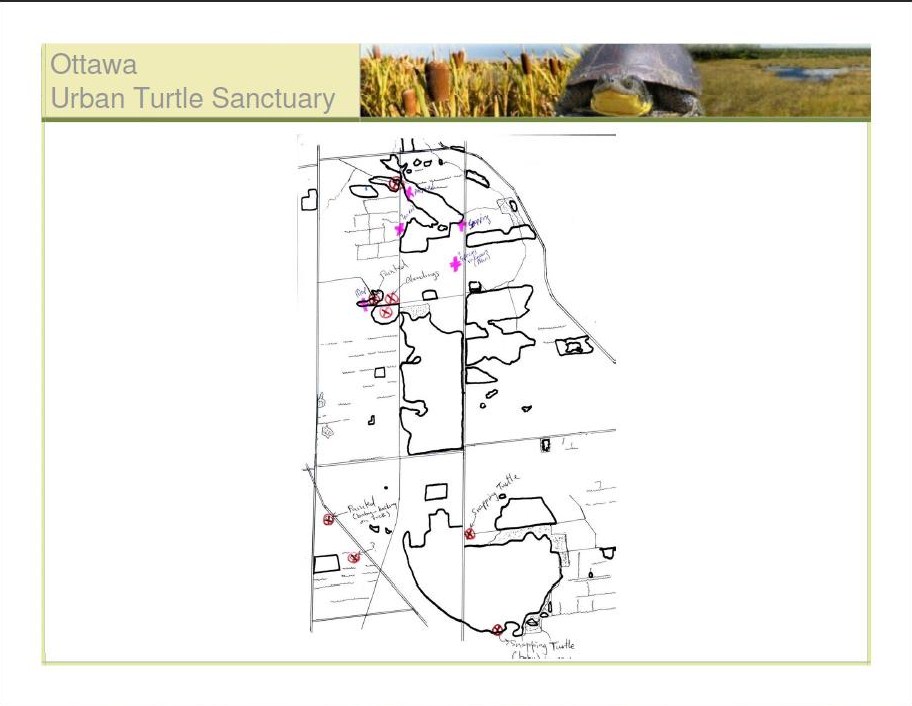
- SAR Turtles found in wetland areas (Map, Painted and now Snapping)

Eight species of turtles live in the Province of Ontario. Four of these species live in the Leitrim  wetlands. This habitat contains: Blanding’s Turtles (THR), Northern Map Turtles (SC), Painted Turtles and Snapping Turtles. While all four of these species are special, 2 of them are on the Province and Federal Species at Risk list. 

With the help of the Rideau Valley Conservation Authority, the Blanding’s Turtle wetlands (Sawmill creek Tributaries 8, 9, 10) was added as part of the overall Sawmill Creek clean up crusade.

(Above map of area in between Hunt Club and Leitrim - Uplands to Bank - shows turtle sightings, etc. )

Taken from Ottawa Urban Turtle Sanctuary Presentation: Finding and fighting for road-free refuges in the National Capital Region (2008 or 2009 presentation?)

This is part of the larger Leitrim Wetland south of Ottawa - where they are building the Findlay Creek development.


Tuesday, February 21, 2012

another parking lot conversion


I'm just collecting all the good news stories about parking lots being reclaimed for nature!! Here's one I just got from my partner:

South Los Angeles Parking Lot Becomes an Inner City Wetland by Perrin Drumm of core77. This used to be an MTA bus parking lot and now it's nine acres of wetland!

Picture by KCET.org

Wednesday, October 5, 2011

Urban Wetland Art (in Toronto)


From Wet Kit:

The Canadian Plastics Industry Association commissioned Noel Harding, to create "The Elevated Wetlands:" a plastic-based, functioning, ecological sculpture. The initiative informs the public of the usefulness, resourcefulness and aesthetic appeal of recycled plastics. "The Elevated Wetlands" is located right beside the Don Valley Parkway, one of Toronto's busiest highways next to the Don Mills Road exit and the Don River.

Solar-run pumps draw water from the polluted Don River into the ponds below the six raised plastic "planters." The water is pumped from the ponds to three of the planters where it flows into three others. The structures use a recycled plastic "soil substitute" to promote vegetative growth that isolates and retrieves wastes, toxins and other impurities from the water. The project was inaugurated on October 1, 1998.


P.S.  Check out my latest "urban wild" nature blog: Wild. Here.(2016 update)

Wednesday, August 10, 2011

amphibian habitat study (Ottawa)

The Geomatics and Landscape Ecology Research Laboratory at Carleton University has also done a conservation study on amphibians to determine the effect of road and land use around local ponds and the effect they have on frog and toad populations.

You can read more about the conclusions of their study and the recommendations in the following online brochure.

A short summary is: Terrestrial habitat of up to 2 kms around breeding sites (ponds, wetlands and wet forests) needs to be conserved along with networks between breeding sites (corridors). Reduced traffic along roads within these boundaries is key. Both forest and open space are important to have a diverse frog and toad population in urban/suburban areas.

Thursday, February 3, 2011

Urban Habitats (New York)


URBAN HABITATS - "An Electronic Journal on the Biology of Urban Areas Around the World"

Urban Habitats is published by the Center for Urban Restoration Ecology (CURE), a collaboration between Brooklyn Botanic Garden and Rutgers University. Articles available here on: flora, wetlands, birds, frogs, etc. It seems that a new volume of this journal is published annually in December with a full pdf of the issue available in January. However the last Volume was published in 2009.

Monday, September 20, 2010

Woods in jeopardy


ENVIRONMENT: Ontario has quietly slashed budgets for buying woods and wetlands

By RANDY RICHMOND, THE LONDON FREE PRESS
September 10, 2010
The cash-strapped Ontario government has quietly slashed its budget for buying significant woods and wetlands, forcing conservation groups to seek private donations to protect the environment.

"Canadians expect the government will look after the environment. The government is not going to do it," said Don Gordon, executive director of the Southwestern Ontario-based Thames Talbot Land Trust.

"Canadians are going to have to do it themselves."

The cuts have come in several ways.

Funding for core programs that help national conservation groups buy and maintain land has been cut in half, from $5 million to $2.5 million. Greenlands Challenge, a provincial fund that provided money to regional land trusts to buy land, has been cancelled for at least one year. Funding for the Ontario Land Trust Alliance, which helps regional land trusts pay legal and survey costs associated with purchases, has been cut 25%.

"The bottom line is, these cuts are impacting very substantially on environmental work being done by volunteers," said Ian Macnab, executive director of the Ontario Land Trust Alliance.

A Natural Resources Ministry spokesperson confirmed the cuts to the three land-buying programs and a "deferral" for at least a year of the Greenlands Challenge. "It is a redeployment of resources," Audrey Tobolka said. The government remains committed to protecting the environment through other programs, and has helped land trusts buy 11,500 hectares of environmentally important land since 2006, she said.

But the NDP's natural resources critic Howard Hampton said the cuts are only the latest from a government that proudly touts its record on the environment while at the same time damaging it. "This is part of a pattern. This government has been cutting the budget of the ministry of natural resources by stealth since 2003," he said. The number of fisheries and forestry workers have been cut across the province, and now in Southern Ontario it will become more difficult to buy environmentally sensitive land, Hampton said. "You are going to have a huge natural environment deficit."

Given a financial deficit reaching $20 billion, the Liberal government is bound to continue cutting, he said.

Land trusts use the money to buy property, already identified by the province as environmentally significant, from private owners. In Southwestern Ontario, the Talbot trust has purchased eight properties, including Meadowlily Nature Preserve in London's southeast end. The lands usually support a rich diversity of species, often including rare or uncommon plants and animals. But the lands also provide an anchor to preserve much larger tracts of land, conservationists say.

For example, the Thames trust is trying to buy the Tanager Tract, a 40-hectare piece of Carolinian forest -- a type of forest with plants and trees more common in the mid-south of the U.S. than in Canada -- near West Lorne. The tract stands at the northwest corner of a much larger, 380-ha forest that's been largely protected over the years but still supports some sustainable logging, Gordon said. The 40-ha Tanager Tract will not only provide a refuge for species during logging or other intrusions into the rest of the forest, but it'll also influence how others use the rest of the tract, he said.

"The thing that makes it even more important is that there are few large natural areas left in southern Ontario."

The Talbot trust has until Nov. 1, when the deal is set to close, to raise the purchase price of $220,000 plus another $65,000 for an endowment fund that supplies an annual source of money for restoration and maintenance work.

The province's Greenlands Challenge Fund would usually supply up to half the money for such a purchase, Gordon said.

"The province very quietly killed the program," he said.

In a bid to get more donations from the public, the Talbot trust is offering tours of the Tanager Tract several Saturdays this fall (visit www.ttlt.ca for more information.) Those land trusts able to find the money to buy land may find it harder to get the funds for the surveys, transfer fees and legal bills for purchases, Macnab said.

Last year, the land trust alliance supported the purchase of 29 properties, but had to turn away another 12 groups seeking help, Macnab said.

This year, with 25% less funding, there could be even more land trusts struggling without the alliance's help, he said.
Image Above: Lisa Sargent-Reed, left, and Nona Irvine walk through the Meadowlily Nature Preserve, a 5.8-hectare piece of property on the south branch of the Thames River and the first property purchased by the Thames Talbot land trust. (MORRIS LAMONT, The London Free Press)